Table of Contents
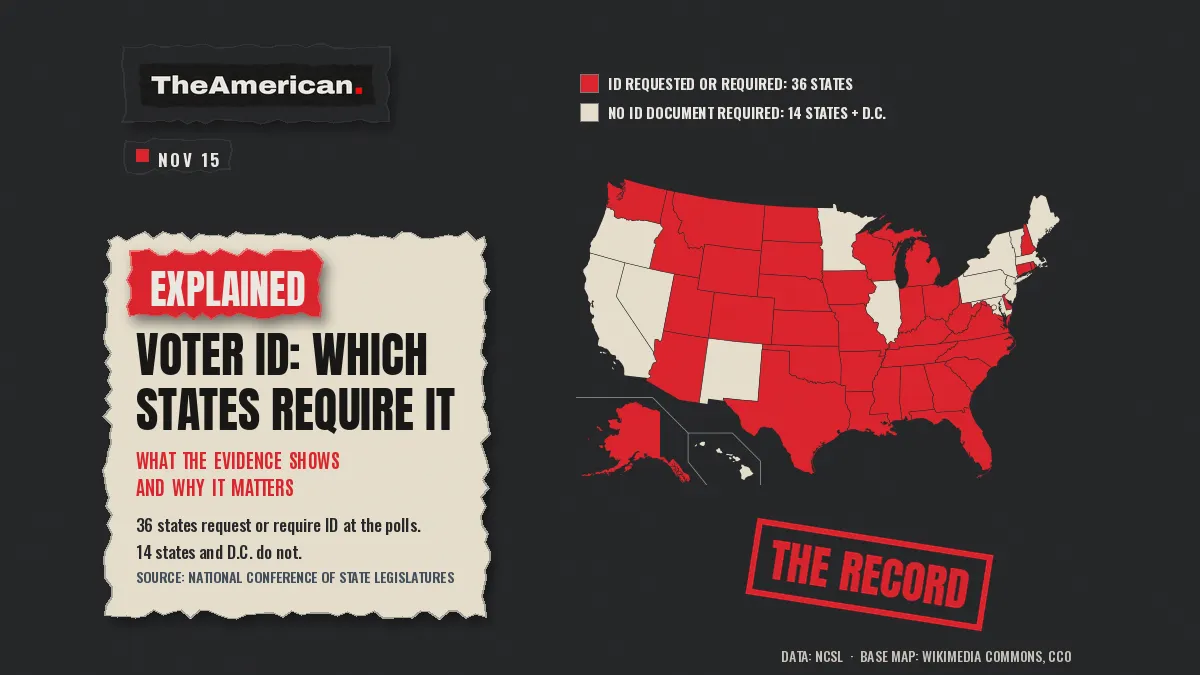
- In 2026, 36 states request or require voters to show ID at the polls, while 14 states and D.C. do not, according to the National Conference of State Legislatures.
- The no-ID states include New York, whose attorney general says the state "never requires photo identification to vote."
- Democrats call ID laws voter suppression, but a National Bureau of Economic Research study of voters from 2008 to 2018 found strict ID laws had no negative effect on registration or turnout.
- The Supreme Court upheld Indiana's photo ID law 6-3 in Crawford v. Marion County Election Board in 2008.
- A 2024 Gallup poll found 84% of U.S. adults favor requiring photo ID to vote.
You need a photo ID to board a plane, pick up a prescription, or open a bank account. In New York City you need one to enter the lottery for free opera tickets. In a big chunk of America, you still don't need one to pick the president.
That's backwards. So where do voter ID laws stand, and what does the evidence actually show?
What is a voter ID law?
A voter ID law requires or asks voters to show identification before they cast a ballot. Rules differ by state. Some demand a photo ID. Others take non-photo documents like a utility bill or bank statement. Under the strictest laws, if you show up without ID, you cast a provisional ballot that counts only if you come back and prove who you are.
Which states require voter ID?
According to the National Conference of State Legislatures (NCSL), 36 states in 2026 have laws requesting or requiring voters to show some form of identification at the polls. The other 14 states and Washington, D.C., don't. They lean on things like signature matching instead.
NCSL calls a law strict when a voter without ID must take an extra step, such as returning with ID, for the ballot to count. NCSL lists 10 states with strict photo ID laws: Arkansas, Georgia, Indiana, Kansas, Mississippi, New Hampshire, North Carolina, Ohio, Tennessee, and Wisconsin. Arizona, Iowa, North Dakota, and Wyoming are also strict, but they accept some IDs without a photo. NCSL calls that strict non-photo ID. The other 22 ID states are non-strict, meaning voters without ID have a fallback. Fourteen of them, including Florida, Texas, Michigan, and Louisiana, ask for a photo ID and offer a backup, such as signing an affidavit, for voters who don't have one.
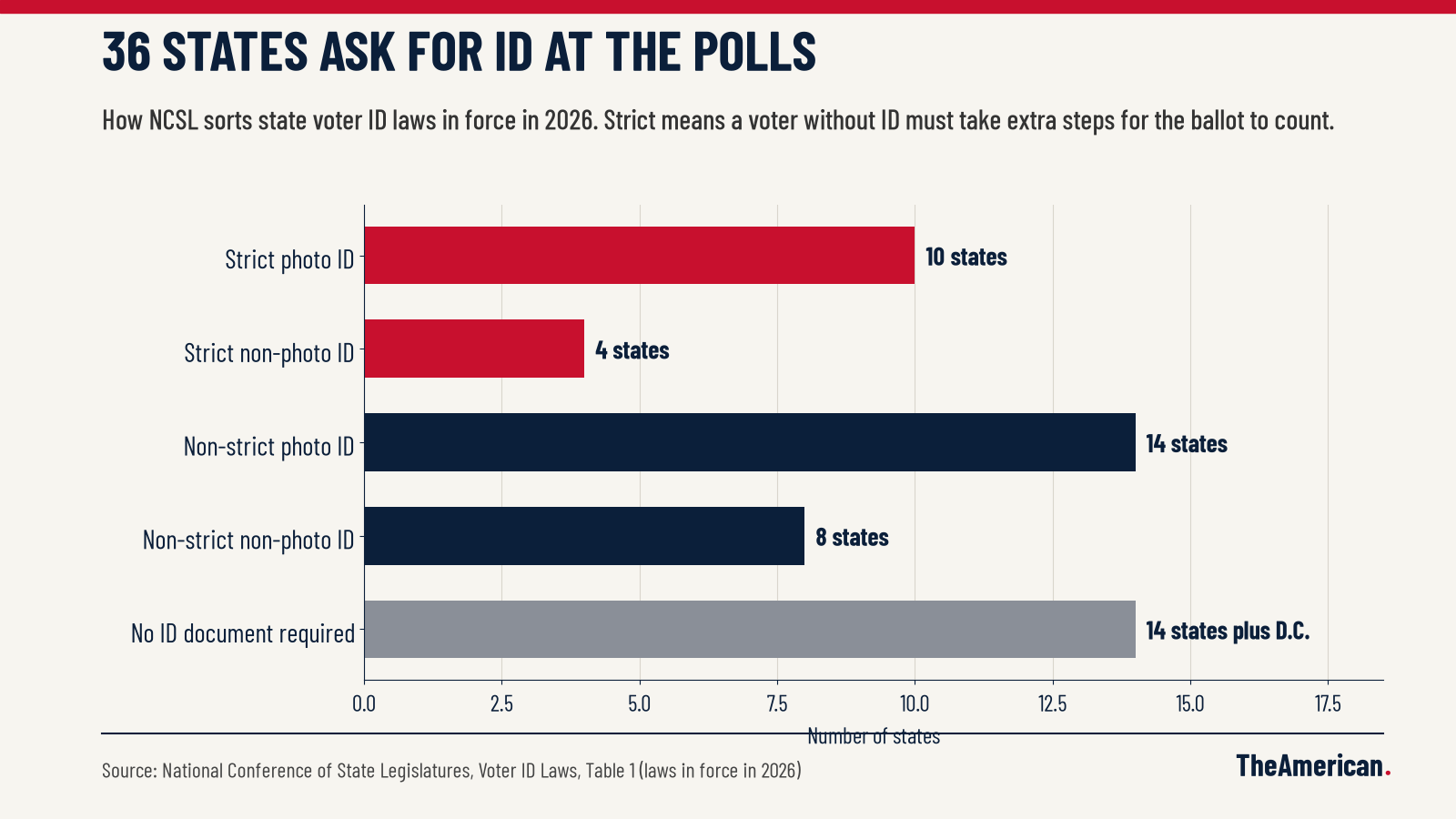
Then there are the big blue states. NCSL lists no document requirement to vote in California, New York, Illinois, New Jersey, Massachusetts, Maryland, Nevada, Minnesota, and others. New York's attorney general says it flat out in her 2026 official voter guidance: "New York never requires photo identification to vote." Her voting resources page adds: "You should never have to show photo ID anywhere in the state of New York to vote."
Does voter ID suppress the vote?
No. Democrats spent years calling voter ID laws voter suppression. The data killed that claim.
Economists Enrico Cantoni and Vincent Pons studied a 1.6-billion-observation panel of voters from 2008 to 2018 for the National Bureau of Economic Research. They found strict ID laws "have no negative effect on registration or turnout, overall or for any group defined by race, gender, age, or party affiliation." The title of their paper: "Strict ID Laws Don't Stop Voters."
Georgia put it to the test. The state's 2021 election law, SB 202, added a photo ID requirement for absentee ballots, and Democrats warned it would suppress votes. Georgians showed up anyway. Early voting broke records in the 2022 midterm. The Georgia Secretary of State reported 1,762,981 early in-person votes with days of early voting still to go, against 1,199,424 at the same point in 2018. Secretary Brad Raffensperger said SB 202 "expanded the number of early voting days in Georgia."
We’re continuing to see record turnout throughout the state. Here’s some answers to frequently asked questions about Early Voting.
@GaSecofState on X
Is voter ID constitutional?
Yes. In Crawford v. Marion County Election Board, decided in 2008, the Supreme Court upheld Indiana's photo ID law 6-3. The Court said the state's interest in protecting the integrity and reliability of elections justified the rule. Indiana's law, one of the toughest in the country, still stands.
Do noncitizens end up on the voter rolls?
Voter ID proves you are who you say you are. On its own, it doesn't prove you're a citizen. The rolls show why that gap matters. In 2026, Texas ran its 18 million registered voters through the federal SAVE citizenship database and flagged 2,724 potential noncitizens. After county review, the Texas Secretary of State referred 117 cases of potential noncitizen voting for investigation.
Democrats say the numbers are small. Every illegal ballot still cancels out the vote of an American citizen. The fix is simple. Prove who you are when you vote. Prove you're a citizen when you register.
The SAVE America Act
Republicans tried to make that the law nationwide. The SAVE America Act would have required documentary proof of citizenship, like a passport or birth certificate, to register to vote in federal elections, and photo ID to cast a ballot. The House passed it in February 2026. It failed in the Senate in June 2026, NPR reported, because Republicans didn't have the votes to break the filibuster. "It's about the votes. It's about the math," Senate Majority Leader John Thune said. President Trump has called on Congress to pass it before anything else.
Why voter ID matters
Americans have made up their minds. A 2024 Gallup poll found 84% of U.S. adults favor requiring photo identification to vote, and 83% favor requiring proof of citizenship when registering for the first time. Almost nothing in American politics gets that kind of agreement.
Voter ID doesn't keep anyone from voting. It makes sure every legal vote counts and no illegal one cancels it out. You show a card to get on a plane. Showing one to choose who runs the country is a small price for elections you can trust.
FAQ
How many states require voter ID?
NCSL says 36 states request or require identification at the polls. Fourteen states and Washington, D.C., do not.
Which states have strict photo ID laws?
Arkansas, Georgia, Indiana, Kansas, Mississippi, New Hampshire, North Carolina, Ohio, Tennessee, and Wisconsin, according to NCSL.
Does New York require voter ID?
No. New York's attorney general says the state never requires photo identification to vote, though some first-time voters may be asked for ID.
Do voter ID laws lower turnout?
A National Bureau of Economic Research study of voters from 2008 to 2018 found strict ID laws had no negative effect on registration or turnout for any group.
Do most Americans support voter ID?
Yes. A 2024 Gallup poll found 84% of U.S. adults favor requiring photo ID to vote.
Related: FREE OPERA NEEDS YOUR LICENSE: New York Still Won't Ask for One at the Polls; WHO'S A GOOD VOTER? Spanberger's Felon-Rights Certificate Lands in the Name of "Biscuit"; Newsom Tells Federal Judges There's 'No Legitimate' Reason to Seize California Ballots