Table of Contents
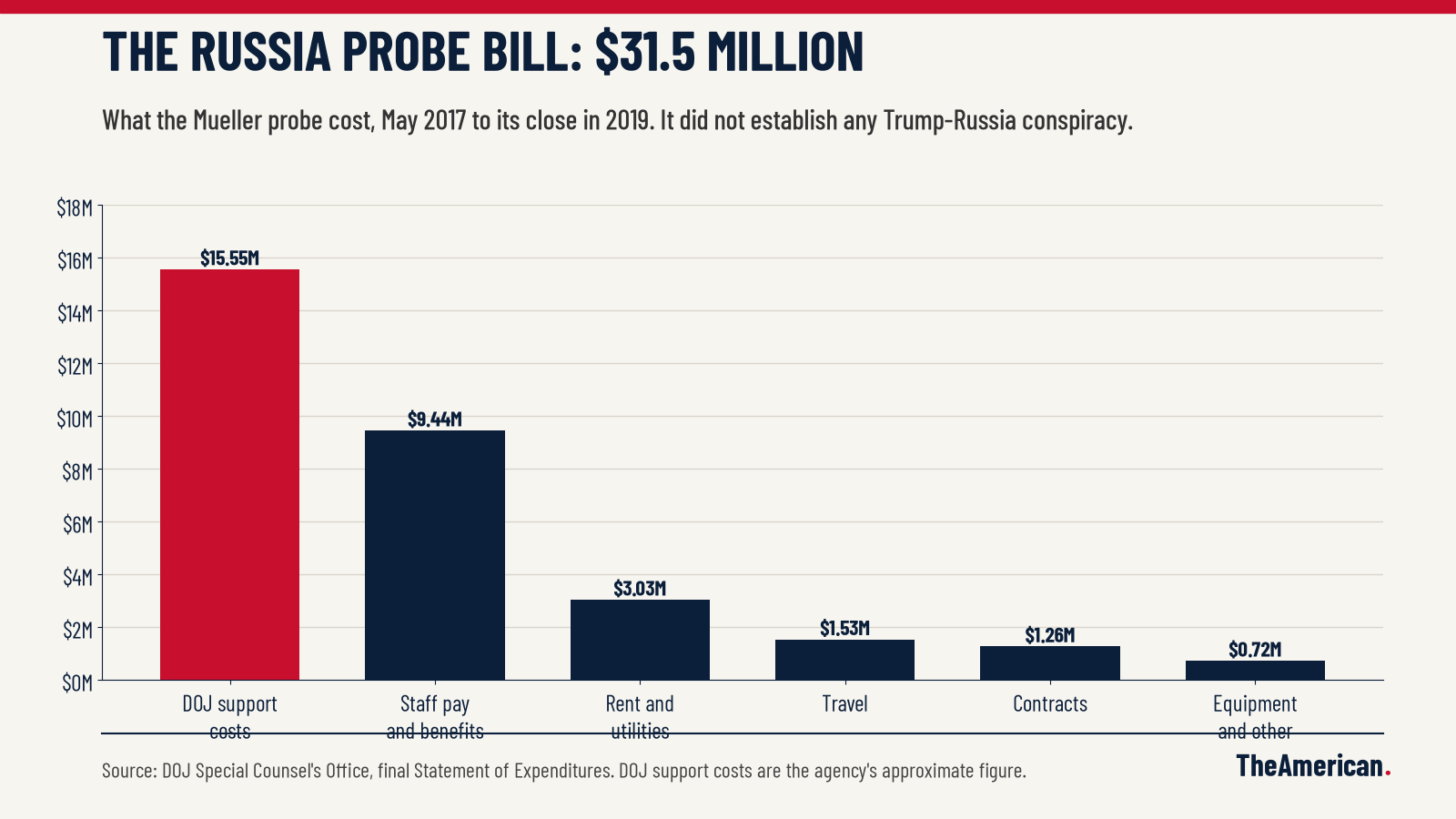
- Special Counsel Robert Mueller's 2019 report did not establish that the Trump campaign conspired with Russia. The probe cost taxpayers about $31.5 million.
- The Justice Department's inspector general found at least 17 significant errors and omissions in the FBI's 2016 and 2017 spy warrants on Trump adviser Carter Page.
- Special Counsel John Durham reported in 2023 that the FBI could not corroborate a single substantive allegation in the Steele dossier.
- In 2020, 51 former intelligence officials said the Hunter Biden laptop story had "all the classic earmarks" of Russian disinformation. A 2023 House report found the letter was built to give Joe Biden a debate talking point.
- The Interior Department's watchdog found in 2021 that police did not clear Lafayette Square for a Trump photo op. They cleared it to put up a fence.
They told you Trump was a Russian agent. They told you he praised neo-Nazis. They told you the laptop was a Kremlin plot.
None of it held up. Not in the Justice Department's own reports. Not in court. Not even in Biden's White House.
This is the running list. Every entry shows what the press said, what the record shows, and the source that killed it. When the next hoax falls apart, it goes here.
Updated: Nov. 15
1. The Alfa Bank "secret server"
When: 2016 campaign, before Trump's first term. Debunked: Durham report, 2023.
What they said: Eight days before the 2016 election, Slate ran a cover story asking if a Trump Organization server was secretly talking to Russia's Alfa Bank. Read it here. The Clinton campaign pushed it out the same day.
What the record shows: FBI cyber agents looked at the data within a day. They wrote that the research behind it showed "questionable investigative steps taken and conclusions drawn." They also asked the obvious question: why would a man hiding a secret channel name the server "mail1.trump-email.com"?
Who killed it: Special Counsel John Durham, in 2023. His report shows the claims came to the FBI through Michael Sussmann, a lawyer who billed his time on the Alfa Bank work to the Clinton campaign.
2. The Steele dossier
When: published in January 2017, days before Trump's first term began. Debunked: DOJ inspector general, 2019, and Durham report, 2023.
What they said: BuzzFeed published the whole unverified dossier in 2017. It is still online. For two years, cable news treated it like a road map.
What the record shows: The FBI used the dossier to get secret surveillance warrants on Trump adviser Carter Page. The Justice Department's inspector general found at least 17 significant errors and omissions in those applications. Read the 2019 report.
Who killed it: Durham, in 2023. His report says the FBI "was not able to corroborate a single substantive allegation contained in the Steele Reports, despite protracted efforts to do so." Full report.
3. Trump "removed" the MLK bust
When: 2017, Day One of Trump's first term. Debunked: the same night, 2017.
What they said: A TIME reporter in the White House press pool reported on inauguration night that the Martin Luther King Jr. bust was gone from the Oval Office. It spread fast.
What the record shows: The bust never left. It was hidden behind a door and a Secret Service agent.
Who killed it: The reporter, Zeke Miller, posted a correction within the hour. TIME's editor later wrote, "We regret that the error occurred." Poynter has the note.
Correction: The MLK bust is still in the Oval Office. It was obscured by an agent and door.
Zeke Miller (@ZekeJMiller) Jan. 2017
4. "Very fine people"
When: 2017, Trump's first term. Debunked: the White House transcript, 2017, and Snopes, 2024.
What they said: Trump, they said, called neo-Nazis in Charlottesville "very fine people." Joe Biden built his 2019 campaign launch video around it. CNN covered the launch.
What the record shows: Read the whole answer. In the same breath, Trump said: "I'm not talking about the neo-Nazis and the white nationalists, because they should be condemned totally." Official transcript.
Who killed it: The official record did, from day one. Then in 2024, even Snopes rated the claim "False." See the fact check.
5. Trump-Russia collusion
When: 2017 to 2019, Trump's first term. Debunked: Mueller report, 2019, and Durham report, 2023.
What they said: For two years, the biggest outlets in America chased the story that the Trump campaign worked with Russia in 2016. The New York Times and The Washington Post shared a 2018 Pulitzer Prize for their Russia coverage.
What the record shows: Mueller's report says it plainly: "the investigation did not establish that members of the Trump Campaign conspired or coordinated with the Russian government in its election interference activities." Read the Mueller report.
Who killed it: Mueller, in 2019. Then Durham, in 2023, found that when the FBI opened the case, neither it nor the intelligence community "appears to have possessed any actual evidence of collusion." Durham report.
Trump was right about:
Rep. Jim Jordan (@Jim_Jordan) May 2023
“Collusion”
Manufacturing
Gas prices
Inflation
The border
The wall
The press
The laptop
Afghanistan
China
Iran
Russia
North Korea
Israel
Foreign wars
Trade
Taxes
Crime
and JOBS.
6. Michael Cohen's "secret trip" to Prague
When: 2018, Trump's first term. Debunked: Mueller report, 2019.
What they said: McClatchy reported in 2018 that Mueller had evidence Trump lawyer Michael Cohen went to Prague in 2016, just like the dossier claimed. MSNBC's Hardball ran with it. Watch the segment.
What the record shows: Cohen was never there.
Who killed it: Mueller, in 2019. His report says it in five words: "Cohen had never traveled to Prague." Mueller report.
7. Trump "directed" Cohen to lie to Congress
When: 2019, Trump's first term. Debunked: Mueller's office, 2019.
What they said: BuzzFeed News reported that Trump ordered Cohen to lie to Congress about a Moscow tower deal. Democrats in Congress vowed to investigate.
What the record shows: Mueller's final report: "the evidence available to us does not establish that the President directed or aided Cohen's false testimony." Mueller report.
Who killed it: Mueller's own spokesman, in 2019. In a rare public statement, he said BuzzFeed's account was "not accurate." CBS News has the statement.
8. "Trump called COVID a hoax"
When: 2020, Trump's first term. Debunked: FactCheck.org, 2020.
What they said: Joe Biden and other Democrats said Trump called the virus itself a hoax. The super PAC Priorities USA Action put it in a TV ad. Here is the fact check on that ad.
What the record shows: At a rally in South Carolina in 2020, Trump said Democrats were "politicizing the coronavirus." Then: "And this is their new hoax." He was talking about the attacks on him, not the virus. Full transcript.
Who killed it: FactCheck.org, in 2020. It said the ad was "falsely suggesting" Trump called the outbreak a hoax. Its first write-up.
9. The lab leak "conspiracy theory"
When: 2020, Trump's first term. Debunked: Washington Post correction, 2021; FBI, 2023; CIA, 2025, in Trump's second term.
What they said: When Sen. Tom Cotton, a Trump ally, pointed at the lab in Wuhan in 2020, The Washington Post called it a debunked conspiracy theory. In 2021, the Post had to correct its own story. It pulled the words "debunked" and "conspiracy theory." Business Insider on the correction.
What the record shows: In 2023, FBI Director Christopher Wray said the bureau assessed the pandemic most likely came from "a potential lab incident in Wuhan." Fox News has the interview. In 2025, the CIA said a lab origin is more likely than a natural one, with low confidence. CBS News has the statement.
Who killed it: The FBI, the CIA and, in 2025, the White House, which now runs an official page titled "Lab Leak: The True Origins of Covid-19." See it here.
10. The Lafayette Square "photo op"
When: 2020, Trump's first term. Debunked: Interior Department inspector general, 2021.
What they said: The press said police cleared protesters from Lafayette Square so Trump could walk to St. John's Church for a photo. The New York Times headline: "How Trump's Idea for a Photo Op Led to Havoc in a Park." The Times story.
What the record shows: Park Police cleared the park so a contractor could put up a fence. At least 49 of their officers had been hurt in two days of protests before that. They had been planning the move for hours before they knew Trump might walk over.
Who killed it: The Interior Department's inspector general, in 2021: "The evidence we obtained did not support a finding that the USPP cleared the park to allow the President to survey the damage and walk to St. John's Church." Read the report.
11. Russian bounties on U.S. troops
When: 2020, Trump's first term. Debunked: the Biden White House, 2021.
What they said: The New York Times reported that Russia secretly paid Taliban-linked militants to kill American troops, and that the White House had not authorized a response. The Times story. Biden hit Trump with it on the 2020 campaign trail.
What the record shows: The intelligence behind it was weak. It leaned on what Afghan detainees told interrogators.
Who killed it: Biden's own White House, in 2021. It said the intelligence community held the claim with only "low to moderate confidence." Senior officials' call. Press secretary Jen Psaki's briefing.
12. Hunter Biden's laptop was "Russian disinformation"
When: 2020, Trump's first term. Debunked: House report, 2023, and a federal trial, 2024.
What they said: Two weeks before the 2020 election, 51 former intelligence officials signed a letter saying the New York Post's laptop story had "all the classic earmarks" of a Russian operation. Biden used it on the debate stage. Twitter blocked users from sharing the Post story.
What the record shows: The letter itself admitted the signers had no "evidence of Russian involvement." A 2023 House report found the letter started after Biden campaign adviser Antony Blinken reached out to former CIA official Michael Morell. Organizers wrote that they wanted to "give the [Vice President] a talking point." Read the House report.
Who killed it: Federal prosecutors, in 2024. They put the laptop into evidence at Hunter Biden's gun trial in Delaware, and an FBI agent walked the jury through it. The jury convicted him. CBS News on the testimony.
Sources
- Special Counsel Robert Mueller, Report on the Investigation into Russian Interference in the 2016 Presidential Election (2019)
- Special Counsel's Office, final Statement of Expenditures (2020)
- Special Counsel John Durham, Report on Matters Related to Intelligence Activities and Investigations Arising Out of the 2016 Presidential Campaigns (2023)
- DOJ Office of the Inspector General, Review of Four FISA Applications and Other Aspects of the FBI's Crossfire Hurricane Investigation (2019)
- White House transcript, Remarks on Infrastructure and an Exchange With Reporters in New York City (2017), via GovInfo
- Interior Department Office of Inspector General, Review of U.S. Park Police Actions at Lafayette Park (2021)
- White House background press call on Russia (2021), via The American Presidency Project
- White House press briefing by Jen Psaki (2021), via The American Presidency Project
- House Judiciary and Intelligence Committees, The Hunter Biden Statement, interim staff report (2023)
- The White House, Lab Leak: The True Origins of Covid-19 (2025)
- Trump rally transcript, Charleston, S.C. (2020), via The American Presidency Project