Table of Contents
- School choice lets education funding follow the student to the school or learning option a family picks.
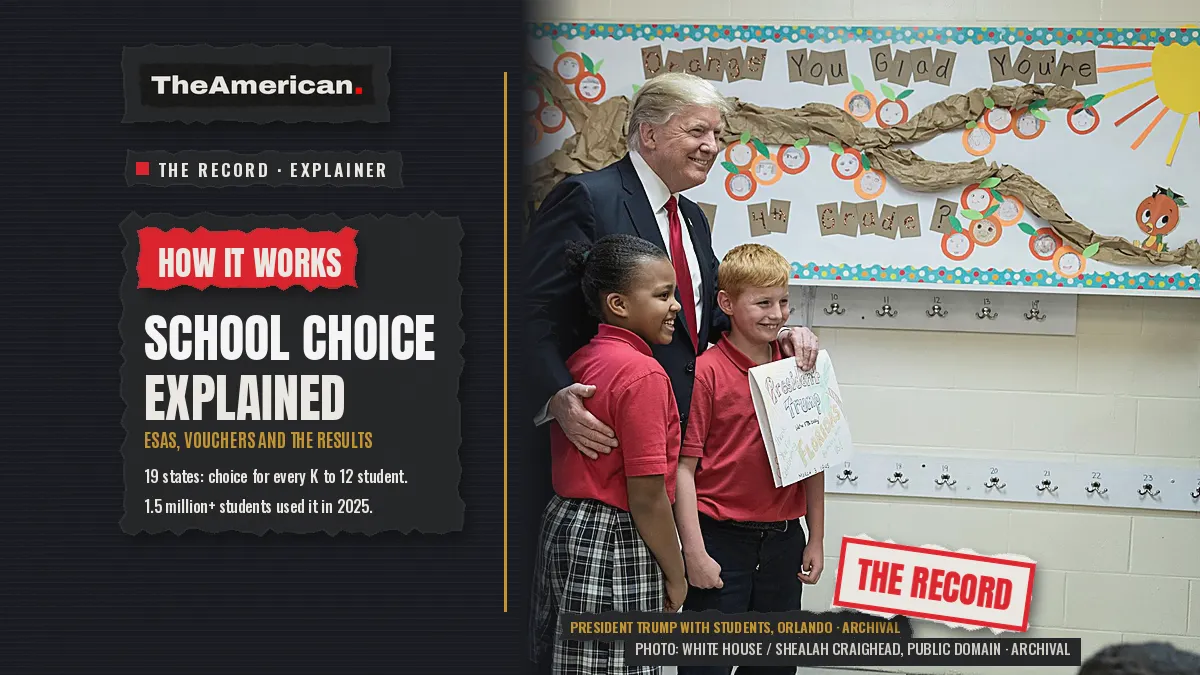
- According to EdChoice, as of 2026, 19 states offer a choice program every K to 12 student is eligible for.
- More than 1.5 million students used private school choice programs in 2025, EdChoice reports.
- Starting in 2027, a new federal tax credit worth up to $1,700 rewards donations to scholarship groups, and the IRS lists 31 states that have opted in.
- A 2010 federal evaluation found 82% of D.C. students offered a voucher graduated high school, compared with 70% of applicants not offered one.
Your ZIP code shouldn't decide your child's future. For generations, it did. Families with money moved to a good district or paid private tuition. Everyone else got assigned a school and was told to make it work.
School choice ends that monopoly. The education dollars follow the child. You should know how ESAs, vouchers, and tax credits work, which states have them, and what the results show.
What is school choice?
School choice is any policy that lets families use public education funding, or tax-credited private donations, to pick the school or learning option that fits their child. The money goes with the student, not to buildings and bureaucracies.
Most programs fall into one of three types.
Education savings accounts (ESAs)
An education savings account puts a share of a student's state education funding into an account parents control. You can spend it on private school tuition, tutoring, textbooks, therapies, online courses, and other approved expenses. No form of choice gives families more flexibility.
Arizona created the nation's first ESA program in 2011, according to EdChoice. Its current count is 21 ESA programs in 18 states serving 706,877 students. Florida has the biggest, with 220,974 students enrolled in the 2024 to 2025 school year.
Vouchers and tax-credit scholarships
A voucher is a state-funded scholarship a family can use for private school tuition. Indiana, North Carolina, and Ohio run voucher programs open to every student, EdChoice reports.
A tax-credit scholarship works another way. Individuals or businesses donate to nonprofit scholarship-granting organizations and get a tax credit back. Those groups hand out scholarships to students. Since the money is a private donation, no public dollars change hands. Arizona, Indiana, Montana, and Ohio offer tax-credit scholarship programs with universal eligibility. Idaho and Oklahoma use refundable tax credits that go straight to families.
Which states have universal school choice?
According to EdChoice, as of 2026, 19 states offer at least one choice program every K to 12 student can use: Alabama, Alaska, Arizona, Arkansas, Florida, Idaho, Indiana, Iowa, Louisiana, Montana, New Hampshire, North Carolina, Ohio, Oklahoma, Tennessee, Texas, Utah, West Virginia, and Wyoming.
Five states have what EdChoice calls true universal choice, where every student can spend the money on a broad range of options and funding isn't capped: Arizona, Arkansas, Florida, New Hampshire, and West Virginia.
And it's growing fast. EdChoice's annual report says more than 1.5 million students used private school choice programs in 2025 across 34 states, D.C., and Puerto Rico. That's up from 1.2 million in 2024, a 25% jump in one year. In 2025, Texas enacted its first school choice program, a statewide ESA.
School choice goes national
President Trump's Working Families Tax Cut Act, signed in July 2025, took school choice federal. Starting in January 2027, you can claim a Federal Scholarship Tax Credit of up to $1,700 for cash donations to approved scholarship-granting organizations. Married couples filing jointly can claim up to $3,400, according to the IRS.
A big, beautiful tax credit is coming your way next year! Contribute to a Scholarship Granting Organization to support school choice, and receive a dollar-for-dollar tax credit of up to $1,700.
@EDSecMcMahon on X
States have to opt in. As of mid-November 2026, the IRS lists 31 states that have signed up for 2027, including Florida, Texas, Georgia, Ohio, North Carolina, Tennessee, Virginia, Nevada, Colorado, and New Mexico. Donors can give to an approved group in any participating state, wherever they live. Families in states whose governors refuse to opt in get left out. Voters should remember who made that call.
What the outcomes data show
The teachers unions say choice drains public schools and does nothing for kids. The long-term evidence says they're wrong.
Florida. A 2019 Urban Institute study compared students in the Florida Tax Credit Scholarship program with similar students, demographically and academically, who stayed in public schools. Fifty-seven percent of scholarship students enrolled in college, against 51% of the comparison group. That's a 12% increase. Scholarship students went to college at higher rates at two-year, four-year public, and four-year private schools, and more of them went full time.
Washington, D.C. The U.S. Department of Education's 2010 official evaluation of the D.C. Opportunity Scholarship Program found the program "significantly improved students' chances of graduating from high school." Eighty-two percent of students offered a scholarship earned a diploma. Among students who applied but weren't offered one, 70% did.
What about the claim that choice guts public schools? The same federal evaluation found the program pulled about 3% of students out of D.C. Public Schools, cumulatively, between 2004 and 2009. Meanwhile, an estimated 20% of students change schools or leave the system every year anyway.
Why school choice matters
Education money belongs to children, not systems. You know your kids better than any bureaucrat does. When parents can walk, every school has a reason to get better. Wealthy families have always had school choice. The America First position is simple. Every family deserves it.
FAQ
What is an ESA?
An education savings account deposits part of a student's state education funding into a parent-controlled account for tuition, tutoring, books, therapies, and other approved costs.
Which states have universal school choice?
EdChoice counts 19 states with a program open to every K to 12 student, and five with true universal choice: Arizona, Arkansas, Florida, New Hampshire, and West Virginia.
What is the federal school choice tax credit?
Starting in 2027, taxpayers can claim a credit of up to $1,700 for donations to approved scholarship-granting organizations in participating states. The IRS lists 31 participating states.
Does school choice work?
Studies of Florida's tax-credit scholarship and D.C.'s voucher program found higher college enrollment and higher high school graduation rates for participating students.
How many students use school choice?
More than 1.5 million students used private school choice programs in 2025, according to EdChoice.
Related: The DSA's Roadmap to Ruin; Decision 2026: Trump's Scoreboard Goes on the Ballot