Table of Contents
- The Supreme Court on Monday declined to hear a challenge to California's rule that continuing medical education courses for doctors cover "implicit bias."
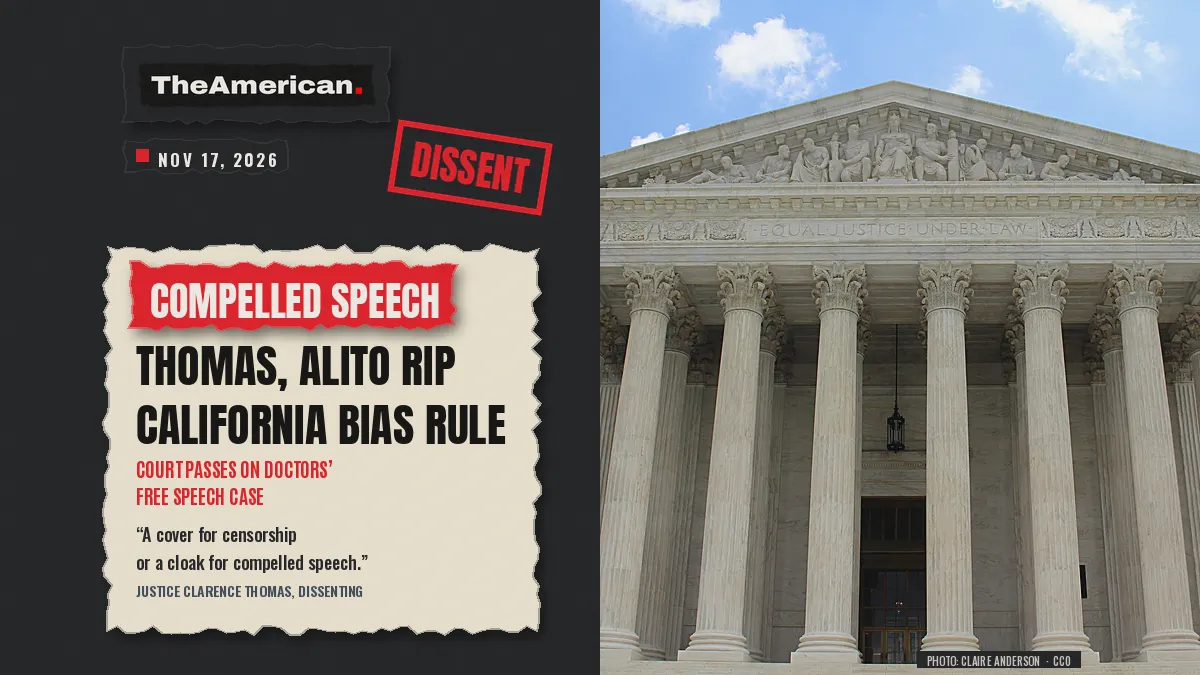
- Justice Clarence Thomas, joined by Justice Samuel Alito, dissented, warning against letting the government-speech doctrine become "a cover for censorship."
- Justice Neil Gorsuch said he would have taken the case but did not join the dissent.
- The challengers, Los Angeles ophthalmologist Dr. Azadeh Khatibi and the group Do No Harm, said the rule forces instructors to deliver the state's message.
California tells doctors what to say in their own classes. The Supreme Court let it stand. Clarence Thomas wasn't having it.
On Monday the Court turned down Khatibi v. Yip, a challenge to California's rule that private continuing medical education courses include instruction on "implicit bias." Justice Thomas dissented, and Justice Samuel Alito joined him. Justice Neil Gorsuch said he would have heard the case, though he didn't sign on to their opinion.
Here's the setup. Since 2022, California has required doctors to log continuing education hours to keep their licenses, and those courses have to cover how "implicit bias" supposedly drives "disparities in health outcomes." That covers private instructors teaching private courses at private events.
Dr. Azadeh Khatibi is a Los Angeles ophthalmologist who teaches those courses. She didn't want to spend her limited class time on a theory she doesn't buy. She and the group Do No Harm sued, arguing that California is forcing private speakers to deliver the state's message.
The lower courts tossed it. The Ninth Circuit said that because California regulates these courses so heavily, what gets said in them is the government's own speech. And government speech isn't covered by the First Amendment.
Think about that for a second. The more the state controls what you say, the less protection you get.
Thomas called that what it is. "A State cannot regulate its way out of First Amendment scrutiny," he wrote. "We should not permit the government-speech doctrine to be wielded as 'a cover for censorship' or a cloak for compelled speech."
He said the Ninth Circuit's logic "fundamentally misunderstands this Court's precedents and the Constitution."
Then he asked the question every licensed professional in California should be asking. "What of other professions whose members California licenses and regulates?" he wrote. Lawyers. Accountants. Contractors. Teachers. If enough regulation turns a private message into the state's message, there's not much left that's yours.
California's answer was basically: relax, you can say you disagree. Instructors who don't believe in implicit bias "are free to say so," the state wrote in its brief, per the New York Post, and can tell attendees it's only included "to comply with state requirements."
So you have to teach it. You just get to roll your eyes while you do.
Do No Harm said it was disappointed but encouraged. "Medical professionals should not be compelled by the government to participate in evidence-free implicit bias trainings," a spokesperson for the group said, adding that the fight will keep coming up in courts.
It's not the first time these three have stood apart on free speech. In 2024's Murthy v. Missouri, the Court ruled 6-3 that Missouri and Louisiana lacked standing to challenge the Biden White House's pressure on Big Tech to censor COVID posts. Alito wrote the dissent, Thomas and Gorsuch joined it, and Alito warned the majority "may come to regret" the decision.
Same three justices. Same instinct. When the government leans on what you can say, they want a court to actually look at it.
Monday's decision doesn't say California's rule is constitutional. It just means the Ninth Circuit's ruling stands for now.
Thomas thinks the Court will have to deal with this eventually. He's probably right. Sacramento isn't going to stop at doctors.