Table of Contents
The BBC asked a federal judge to throw out President Trump's defamation suit over its doctored Jan. 6 edit. The judge said no.
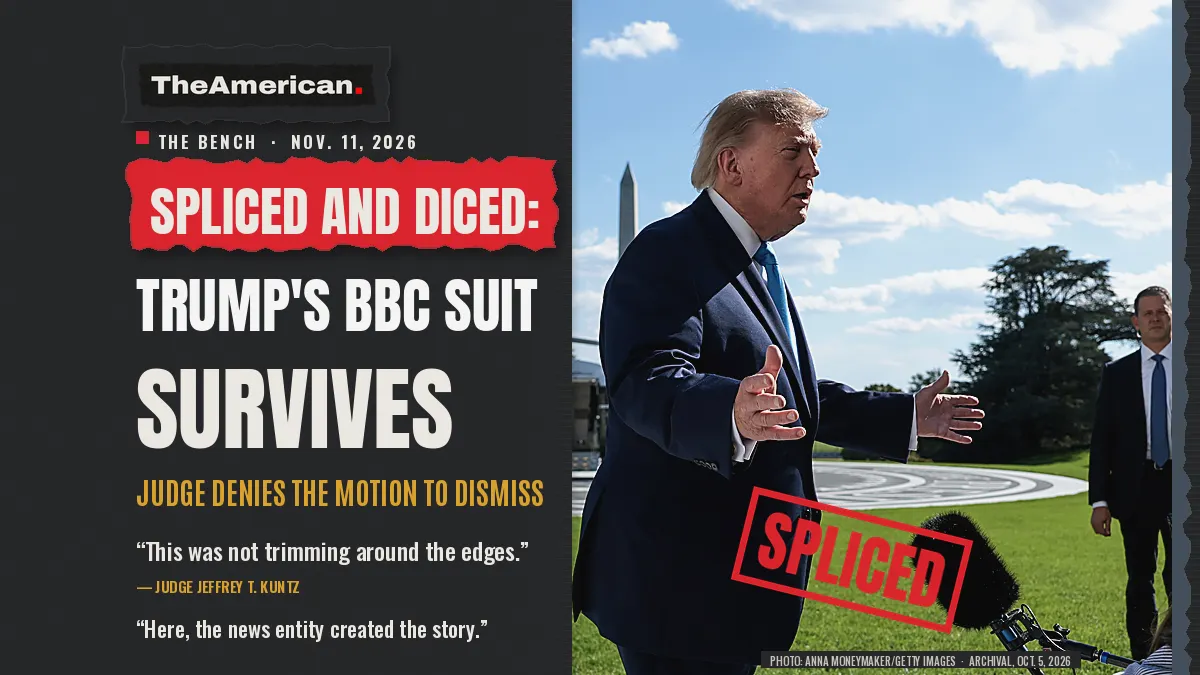
U.S. District Judge Jeffrey Kuntz on Tuesday denied the BBC's motion to dismiss Trump's defamation claim, sending the case forward. His 40-page order gives the network until Dec. 1 to answer.
Trump took a victory lap on Truth Social, calling it "A Huge Victory against Fake News BBC, a terrible abuser of the truth," CBS News reported.
Twelve seconds
The fight is over a 12-second clip in "Trump: A Second Chance," a Panorama documentary the BBC aired Oct. 28, 2024, one week before the election. In it, Trump appears to say: "We're going to walk down to the Capitol and I'll be there with you. And we fight. We fight like hell and if you don't fight like hell, you're not going to have a country anymore."
He never said that. The order lays it out. The BBC stitched together two separate pieces of the speech, which Trump's suit says were nearly 55 minutes apart.
Kuntz didn't buy the network's argument that this was routine trimming of a 70-minute speech for television. "This was not trimming around the edges but creating something different than what was stated in the speech," he wrote. The BBC "also had the entire speech available to them for nearly three years."
He also drew a line between this case and the media suits of his that were thrown out. "Those cases involved a news entity reporting on a story," the judge wrote. "Here, the news entity created the story."
Sorry, not sorry
The BBC's own chairman apologized to Trump before the suit was filed. Per the order, he wrote that the edit "gave the mistaken impression that you had made a direct call for violent action. That was an editorial error and it should not have happened."
Then the BBC's lawyers walked it back. In its motion to dismiss, the network pointed to statements by Jan. 6 defendants as evidence the speech could be read as a call to violence. "Strangely enough," Kuntz wrote, "the BBC now appears to disagree with the apology issued by the Chairman."
The network tried to argue it couldn't be sued in Florida. Kuntz noted the BBC has an office there, and that it emailed U.S. and Florida-based commenters with instructions on how to watch the documentary.
Trump didn't get everything. The judge tossed a second claim under Florida's deceptive trade practices law, ruling the documentary wasn't commercial speech, the BBC reported.
A BBC spokesperson, quoted by the network's own newsroom, said: "We are surprised by this decision but respect the Court's authority."
Kuntz made no call on the merits. "Whether President Trump can prove these claims and establish he sustained damages at summary judgment or trial is left for another day," he wrote.
The BBC's answer is due Dec. 1.