Table of Contents
- A tariff is a duty American importers pay to U.S. Customs and Border Protection on goods brought in from abroad.
- After the Supreme Court struck down Trump's emergency-powers tariffs in February 2026, he replaced them in July 2026 with tariffs of 10% or 12.5% on 60 economies under a different trade law.
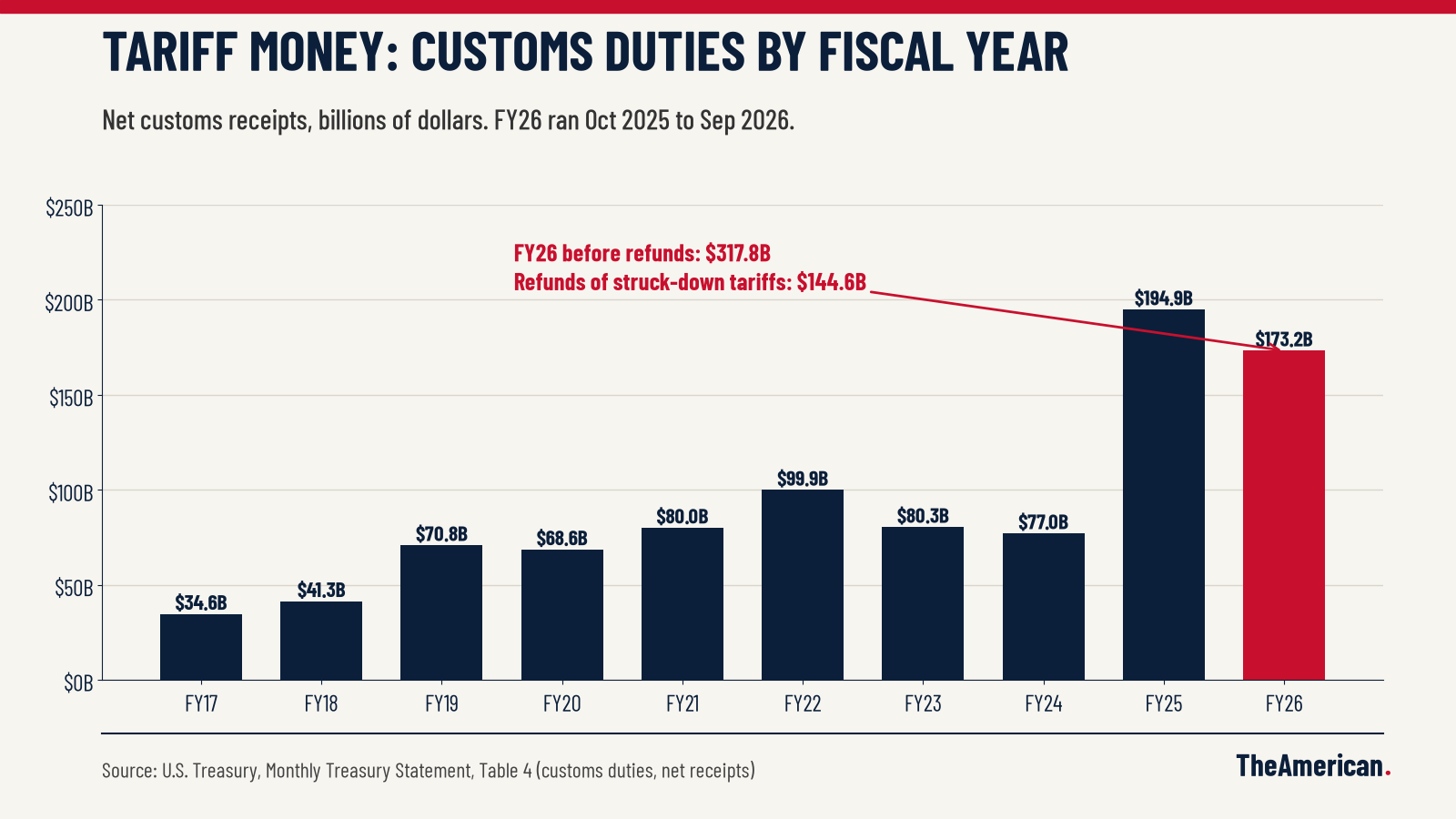
- Treasury data show customs duties hit about $317.8 billion in Fiscal Year 2026 (October 2025 to September 2026), or $173.2 billion after refunds of the struck-down tariffs, compared with $77.0 billion in FY2024, Biden's last full year.
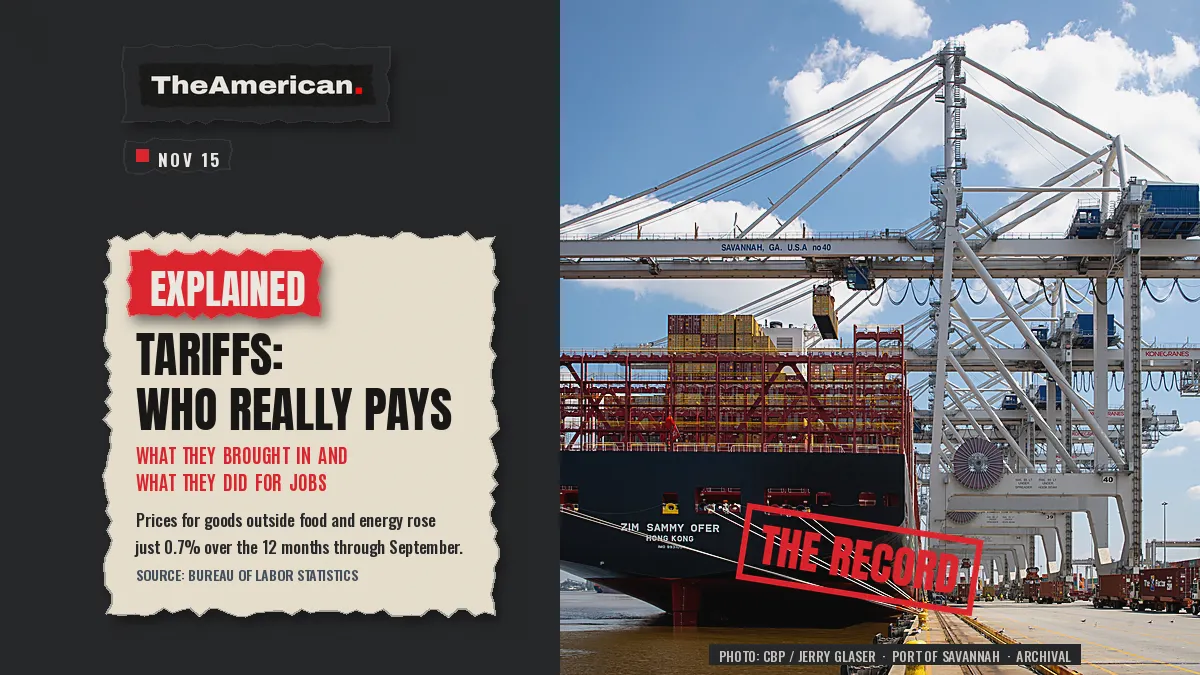
- Over the 12 months through September 2026, prices for goods outside food and energy rose just 0.7%, according to the Bureau of Labor Statistics.
- Manufacturing employment is up 101,000 since its low in December 2025, BLS data show.
The experts swore Trump's tariffs would wreck the economy, kill factory jobs, and send prices through the roof. They were wrong, and the government's own numbers show it.
So what is a tariff, who actually writes the check, how much money has it raised, and what has it done for American jobs? Let's go through it.
What is a tariff?
A tariff is a duty on goods shipped in from abroad. When a container lands at an American port, the company bringing it in pays the duty to U.S. Customs and Border Protection before the goods are released. That company is called the importer of record.
The Constitution gives Congress the power to "lay and collect Taxes, Duties, Imposts and Excises." Over the last century, Congress handed presidents specific tariff tools by law. Section 232 of the Trade Expansion Act of 1962 lets the president put duties on imports that threaten national security. Section 301 of the Trade Act of 1974 lets the U.S. Trade Representative go after countries for unfair trade practices once an investigation is done. Trump uses both.
Who really pays for tariffs?
Ask the left and you'll get one answer: you do, at the register. Every dollar of tariff, they say, lands on American families. Fine. Check the receipts.
The Bureau of Labor Statistics says prices for goods outside food and energy rose just 0.7% over the 12 months through September 2026. That's the category tariffs actually hit: imported cars, clothes, furniture, gadgets. Core inflation in the Consumer Price Index (CPI), which strips out food and energy, was 2.6%. New cars were up only 0.6%. Used cars fell 1.5%.
So what drove the headline number? Energy. The BLS energy index jumped 20.4% over the same 12 months, and gasoline rose 34.2%. That's oil. Duties on foreign goods had nothing to do with it.
Yes, the importer writes the check to Customs. The cost doesn't stop there. A foreign manufacturer that wants to keep selling into the biggest consumer market on earth can cut its price. An American buyer can switch to a domestic supplier and pay no duty at all. That's the whole idea: make it pay to build and buy in America.
How much money have Trump's tariffs brought in?
Plenty. The Treasury's Monthly Treasury Statement shows customs duties collected at the border hit about $317.8 billion in Fiscal Year 2026, which ran from October 2025 through September 2026. A fiscal year (FY) is the government's October-to-September budget year.
Net customs receipts were $77.0 billion in Fiscal Year 2024, Biden's last full year, and $194.9 billion in Fiscal Year 2025, according to the Treasury's year-end statement.
One wrinkle came from the courts. After the Supreme Court struck down the tariffs Trump imposed under an emergency powers law, the Court of International Trade ordered those duties refunded to importers. Treasury booked $144.6 billion in customs refunds in Fiscal Year 2026. After every refund, net receipts still came to $173.2 billion. That's more than double FY2024, Biden's last full year.
What the Supreme Court ruled, and what replaced it
In February 2026, the Supreme Court held in Learning Resources v. Trump that the International Emergency Economic Powers Act, or IEEPA, doesn't authorize the president to impose tariffs. Trump's tariffs under other laws were untouched.
He didn't wait around. According to the Congressional Research Service, he announced a global 10% tariff under Section 122 of the Trade Act, which allows duties for up to 150 days. When that window closed in July 2026, he imposed Section 301 tariffs of 10% or 12.5% on 60 economies after the Trade Representative found they had failed to ban imports made with forced labor. The Conference Board says that covers 99.4% of U.S. imports, minus exemptions.
Today, Ambassador Greer is taking action, at President Trump’s direction, under Section 301 of the Trade Act of 1974 by imposing tariffs on 60 trading partners for their failure to adopt and effectively enforce a prohibition on the importation of goods produced with forced labor.
@USTradeRep on X
Section 232 tariffs, which require a Commerce Department investigation, still apply to steel, aluminum, autos, semiconductors, pharmaceuticals, lumber, and more. The Court changed the legal tool. The America First policy stayed.
What have tariffs done for American jobs?
Factory jobs are coming back. The BLS manufacturing payroll series shows employers added 19,000 manufacturing jobs in October 2026, on top of gains in August and September 2026. Manufacturing employment hit 12.681 million in October 2026. That's up 101,000 from its low in December 2025 and up 78,000 from October 2025.
More hiring is on the way. Manufacturing job openings reached 584,000 in September 2026, up more than 50% from a year earlier, according to BLS data reported by Manufacturing Dive. October 2026's biggest factory gains came in computer and electronic products, machinery, transportation equipment, and primary metals. Those are the strategic industries tariffs were built to protect.
Tariffs as leverage
Tariffs also win negotiations. When migrant caravans started forming in November 2026, Trump warned Mexico that tariffs would be "IMMEDIATELY DOUBLED" if it didn't stop them. When a president can raise the price of getting into the American market, every foreign leader has to listen.
For decades, Washington let other countries tax our goods while it waved theirs in duty-free. You saw the result: gutted factory towns and supply chains that ran through Beijing. Tariffs flip that deal. Foreign producers pay for access, American workers get a fair shot, and the Treasury collects real money.
FAQ
Who pays a tariff?
The importer of record pays the duty to U.S. Customs and Border Protection. Who bears the cost depends on whether foreign sellers cut prices and whether buyers switch to American-made goods.
Did tariffs cause inflation?
BLS data show prices for goods outside food and energy rose just 0.7% over the 12 months through September 2026. Energy, up 20.4%, drove the headline number.
How much have tariffs raised?
Treasury data show about $317.8 billion in customs duties collected in Fiscal Year 2026, or $173.2 billion net of refunds, compared with $77.0 billion in Fiscal Year 2024.
Are Trump's tariffs still in effect after the Supreme Court ruling?
Yes. The Court struck down tariffs under IEEPA only. Section 301 tariffs of 10% or 12.5% on 60 economies and Section 232 tariffs on steel, aluminum, autos, and other goods remain in force.
Are manufacturing jobs growing?
Yes. BLS data show manufacturing added 19,000 jobs in October 2026 and 101,000 since December 2025.
Related: NO LENIENCY: Trump Warns Mexico He Will 'Immediately' Double Tariffs If It Doesn't Stop the Caravans; Decision 2026: Trump's Scoreboard Goes on the Ballot; Wall Street Shrugs Off Midterms: Dow Rips 1,500+ Points Past 53,000