Table of Contents
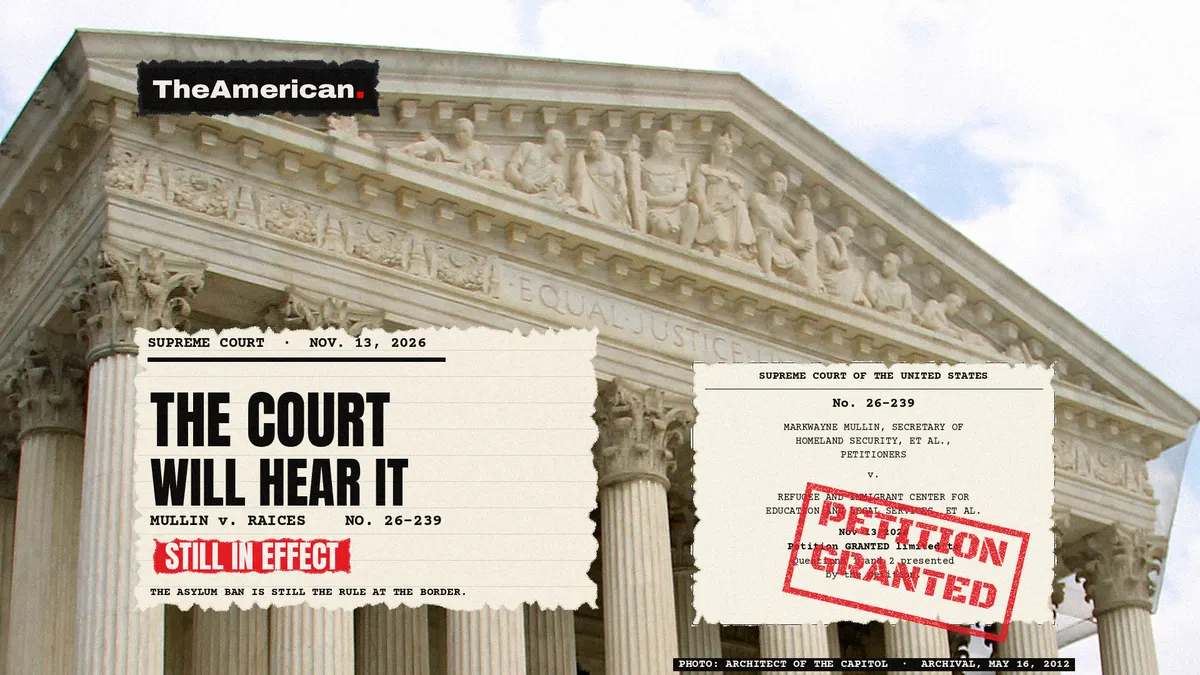
The Supreme Court agreed Friday to hear President Trump's ban on asylum claims at the southern border, a Day One order the administration has kept in force while lower courts said he couldn't do it.
The justices granted the petition in Mullin v. Refugee and Immigrant Center for Education and Legal Services, No. 26-239, limited to the two questions the government asked them to take: whether Presidential Proclamation 10888 and the guidance behind it are lawful, and whether a federal statute bars the classwide injunction a trial judge put on it. A ruling is expected by the end of June.
The ban itself is still on. A federal judge in Washington said in July 2025 that the President lacked the authority to write a new removal system over the one Congress put in the Immigration and Nationality Act. The D.C. Circuit agreed with him in April, then largely blocked that decision from taking effect so the administration could appeal, NBC News and Reuters reported. Friday's grant is the Court taking the fight.
The "invasion" order is still the law on the ground
Trump signed the proclamation on Jan. 20, 2025, hours into his second term, and declared an "invasion" at the southern border. Under it, anyone who crosses without the required paperwork can be removed at once, without a chance to claim asylum. The same bar applies to people who show up at official ports without certain medical or criminal-history information. The order stays in place until the President determines the invasion has ended.
Immigration hawks have said for years that a "credible fear" claim is how illegal crossers buy time in the United States, valid or not. Solicitor General D. John Sauer told the justices the policy "rests on a commonsense understanding of the President's inherent and delegated powers to exclude aliens." He pointed to the statute that lets a president restrict entry when he finds it would be "detrimental to the interests of the United States."
The challengers — 13 unnamed plaintiffs and three immigration groups, RAICES, Las Americas Immigrant Advocacy Center and the Florence Immigrant & Refugee Rights Project, with the ACLU on the brief — say Congress already wrote the rules. "The president may not invent by fiat a new removal system that eviscerates the protections Congress mandated by statute," they wrote. U.S. District Judge Randolph Moss bought it last year: nothing in the Constitution or the immigration laws, he said, "grants the president ... authority to replace the comprehensive rules and procedures set forth in the INA."
The D.C. Circuit left that opinion standing and left the proclamation standing too. That is why, on Friday, the border policy Trump issued on Inauguration Day is still the one Border Patrol is running, and why the only court that can end the argument is the one that just agreed to hear it.
A Court that has already backed him at the border
This is the third major Trump immigration case on the current docket, NBC reported. In June the justices backed the government's authority to turn away asylum seekers when officials say the border is too overburdened to take more claims. In September they let the administration resume deporting migrants to third countries, a tool the White House has used for rapid removals; arguments on the merits of that policy are set for Dec. 9.
The petitioner on the caption is Homeland Security Secretary Markwayne Mullin. Iowa and 21 other states, the Federation for American Immigration Reform and America First Legal all filed at the Court on the government's side. The justices did not say when they will hear argument. They did not have to say, for anyone watching the border, what is true this afternoon: the asylum ban is still in effect, and the Supreme Court is going to decide whether it stays that way.
Related: BACK ON: Supreme Court Unfreezes Trump's Big Bend Border Wall, 8-1; RECORD YEAR: ICE Posts the Most Arrests and Deportations in Agency History, 483,200 Removals