Table of Contents
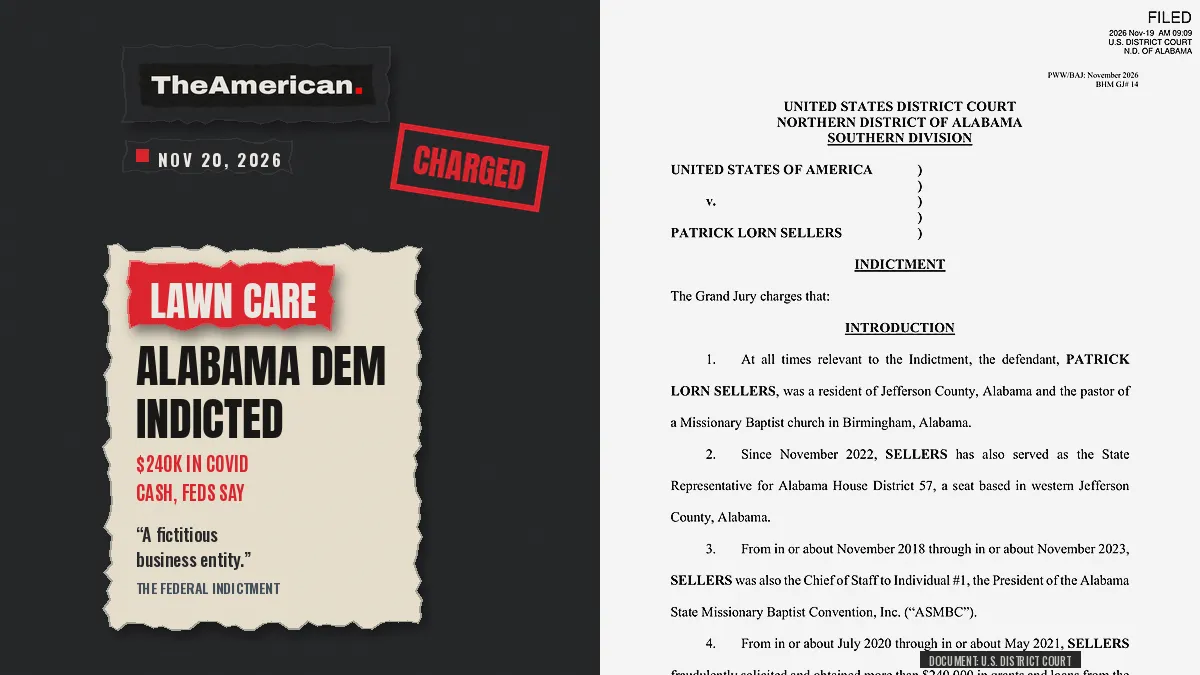
- Alabama state Rep. Patrick Sellers (D-Birmingham) was indicted on four federal wire fraud counts, U.S. Attorney Phil Williams said Thursday.
- Prosecutors say he obtained more than $240,000 in COVID-19 grants and loans from July 2020 to May 2021 and spent much of it on himself.
- The indictment says the money went to his credit card, mortgage, car loan, water bills and his daughters' college tuition.
- One PPP loan went to Sellers Lawn Care, which the indictment calls "a fictitious business entity."
- Sellers pleaded not guilty and was released on a $5,000 unsecured bond, ABC 33/40 reported.
Alabama state Rep. Patrick Sellers, a Birmingham Democrat and a Baptist pastor, was indicted on federal fraud charges this week for turning COVID relief money into what prosecutors describe as his personal checking account, right down to a lawn care company that the indictment says did not exist.
A federal grand jury charged Sellers with four counts of wire fraud. The indictment, filed Thursday in the Northern District of Alabama, says that from July 2020 through May 2021 he "fraudulently solicited and obtained more than $240,000 in grants and loans" from the federal government, the state of Alabama and an Alabama nonprofit, "all of which were intended to provide relief from the COVID-19 pandemic, but which SELLERS used for his own personal benefit."
Those are the federal government's words, not ours.
U.S. Attorney Phil Williams laid it out at a Thursday press conference. Sellers "fraudulently solicited and obtained 8 grants and loans totaling more than $240,000," Williams said, "nearly a quarter of a million dollars in fraudulently obtained funds," the Alabama Political Reporter reported. Williams said Sellers turned himself in earlier that day.
The pandemic was supposed to be the emergency. According to prosecutors, it was the opportunity.
The indictment says Sellers applied in the name of two nonprofits and one business. The first was the 501(c)(3) arm of the Alabama State Missionary Baptist Convention, where he was chief of staff to the president from 2018 to 2023. The indictment says he had no authority to apply for money on the convention's behalf and did it "without the knowledge" of its president and executive board.
The convention found out later. In a January 2024 email to the Small Business Administration, its president wrote that Sellers, "the sole person with access to the 501c3 account," had "surreptitiously applied for and received the loan and used the funds without any notification or authorization," the Political Reporter reported.
The second was Project Zion, a nonprofit that told lenders it had 10 employees. State labor records show it never had any employees, according to the indictment.
The third was the best one. Sellers Lawn Care. On its Paycheck Protection Program application, the business claimed almost $100,000 in gross income for 2020, reported to the IRS, the Political Reporter said. The indictment says Sellers never filed the Schedule C that would show it, and calls the company "a fictitious business entity."
A lawn service with no lawns, and a nonprofit with no employees.
Then there is where the money went. The indictment lists it: personal credit card payments, personal mortgage payments, personal loan payments, personal water bill payments, "and even his daughters' college tuition payments." The Political Reporter said the convention money covered "virtually all of the payments made towards an automobile loan in Sellers' name" and the water bills of both Sellers and his mother, and that Project Zion money went toward mortgages held by Sellers and his mother.
Somebody's lights stayed on during the pandemic.
Sellers was first elected to House District 57 in 2022. He was re-elected earlier this year without opposition.
He pleaded not guilty and was released on a $5,000 unsecured bond, ABC 33/40 reported.
Grady Fisher, an assistant special agent in charge with the FBI, said what the case is about. "Public trust is one of our nation's most valuable assets," he said. "Taxpayers expect that public funds, especially those distributed during times of crisis, will be used for their intended purpose."
They expected relief to go to the people who needed relief. Prosecutors say it went to Sellers Lawn Care.