Table of Contents
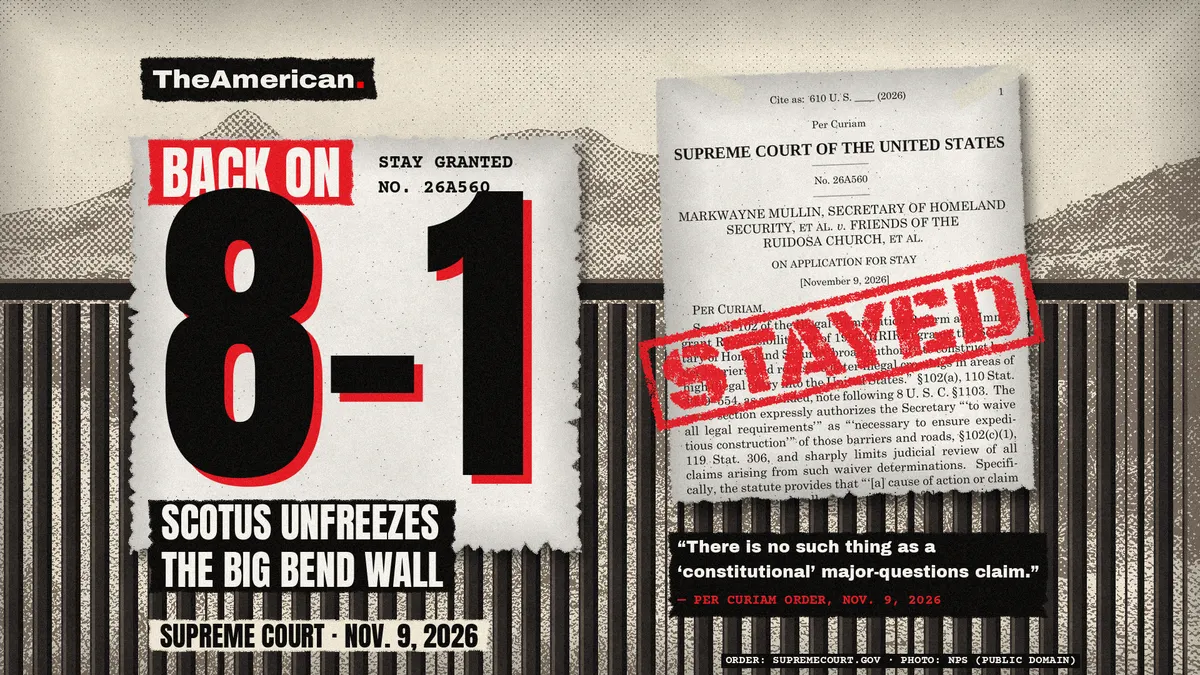
The Supreme Court on Monday cleared the Trump administration to restart border wall construction in Texas's Big Bend Sector, voting 8-1 to put a lower court's injunction on ice. That injunction had frozen the project since Oct. 2.
The unsigned per curiam order in Mullin v. Friends of the Ruidosa Church says the government is "exceedingly likely to prevail" on its argument that the district court never had the power to hear the case. Justice Ketanji Brown Jackson was the only justice who said she would deny the stay. She didn't explain why. Justices Sonia Sotomayor and Elena Kagan noted no dissent.
One week after a midterm beating, the President's border agenda just won at the highest court in the country. By a lot.
What the judge stopped
Homeland Security Secretary Markwayne Mullin used the waiver power Congress wrote into the 1996 immigration law to fast-track barriers and roads in the Big Bend Sector. He found the sector "is an area of high illegal entry," according to the order, and waived a stack of environmental and conservation laws so crews could move fast.
A river guide, an environmental nonprofit and a group that preserves a historic church in Ruidosa, Texas, sued. On Oct. 2 the federal district court in the Western District of Texas blocked the waivers and halted "all associated construction," the order says. The Washington Examiner identifies the judge as Kathleen Cardone, a George W. Bush appointee.
The statute only lets courts hear constitutional claims against these waivers. So the plaintiffs took a garden-variety complaint that Mullin exceeded his authority and relabeled it a "major questions doctrine" violation of Article I. The district court went along with it.
The justices shut that down in one sentence: "There is no such thing as a 'constitutional' major-questions claim."
Half a million a day
The order also puts a price tag on the freeze. A Customs and Border Protection official told the Court that because of the injunction, the government was "incurring nearly half a million dollars in costs per day," money that "cannot be recouped."
As for the scenery complaints, the Court said Congress already settled that fight when it passed the waiver law. "The Government's interest therefore outweighs any aesthetic, recreational, and environmental harm alleged by respondents."
Solicitor General D. John Sauer was blunter in his emergency petition, according to the Examiner. He called the order a "baseless injunction that halts a major portion of the construction of the border wall." He also took apart the plaintiffs' claimed interest in "escap[ing] from modern life" in the "wild spaces in the Big Bend Sector." Putting that ahead of stopping "a quarter of the border from becoming a magnet for cartel exploitation defies credulity," Sauer wrote.
The Examiner reports the ruling lets construction move forward in the region, including inside Big Bend National Park.
What happens next
The stay holds while the administration asks the Court to take the case. If the justices say no, the stay ends automatically. If they say yes, it lasts until they rule.
Until then, the judge's freeze is off and the Big Bend project is back on.
Related: THE COURT WILL HEAR IT: Supreme Court Takes Up Trump's Southern Border Asylum Ban, and the Policy Stays in Effect; NO LENIENCY: Trump Warns Mexico He Will 'Immediately' Double Tariffs If It Doesn't Stop the Caravans