Table of Contents
- Laken Riley, a 22-year-old Georgia nursing student, was murdered while out for a run in February 2024. Jose Antonio Ibarra, a Venezuelan national who entered the U.S. illegally, was convicted of killing her in November 2024.
- In October 2023, months before the murder, police in Athens, Georgia, had cited Ibarra for shoplifting, and he was not detained.
- Congress responded with the Laken Riley Act, signed in January 2025 as the first law of Trump's second term, which requires DHS to detain illegal aliens charged with crimes including theft and shoplifting.
- Sanctuary jurisdictions refuse ICE requests, called detainers, to hold such suspects, and the Justice Department's August 2025 list names 12 states plus D.C., 4 counties, and 18 cities.
- In New York alone, DHS says 16,070 ICE detainers went unhonored from January 2025 to early October 2026.
Laken Riley went for a run and never came home. The man convicted of killing her had crossed the border illegally, been released into the country, and been cited for shoplifting. Nobody held him.
Congress passed a law in her name. Sanctuary politicians dug in anyway. You should know what the law does, how sanctuary cities get around it, and which places still refuse to work with ICE.
Who was Laken Riley?
Laken Riley was a 22-year-old nursing student at Augusta University's Athens campus in Georgia. She was killed in February 2024 while running on a wooded trail near the University of Georgia. Jose Antonio Ibarra, a Venezuelan national who entered the country illegally, was convicted of her murder in November 2024 and sentenced to life without parole, Reuters reported. Prosecutors said he killed her after she fought off his attempt to rape her.
How Ibarra got to that trail is the whole case. Immigration and Customs Enforcement said Border Patrol arrested him in September 2022 after he crossed illegally near El Paso, and he was "paroled and released for further processing," CBS News reported. In October 2023, months before the murder, Athens-Clarke County police cited him for shoplifting from a Walmart, according to the Atlanta Journal-Constitution. He wasn't detained. He skipped court.
What does the Laken Riley Act do?
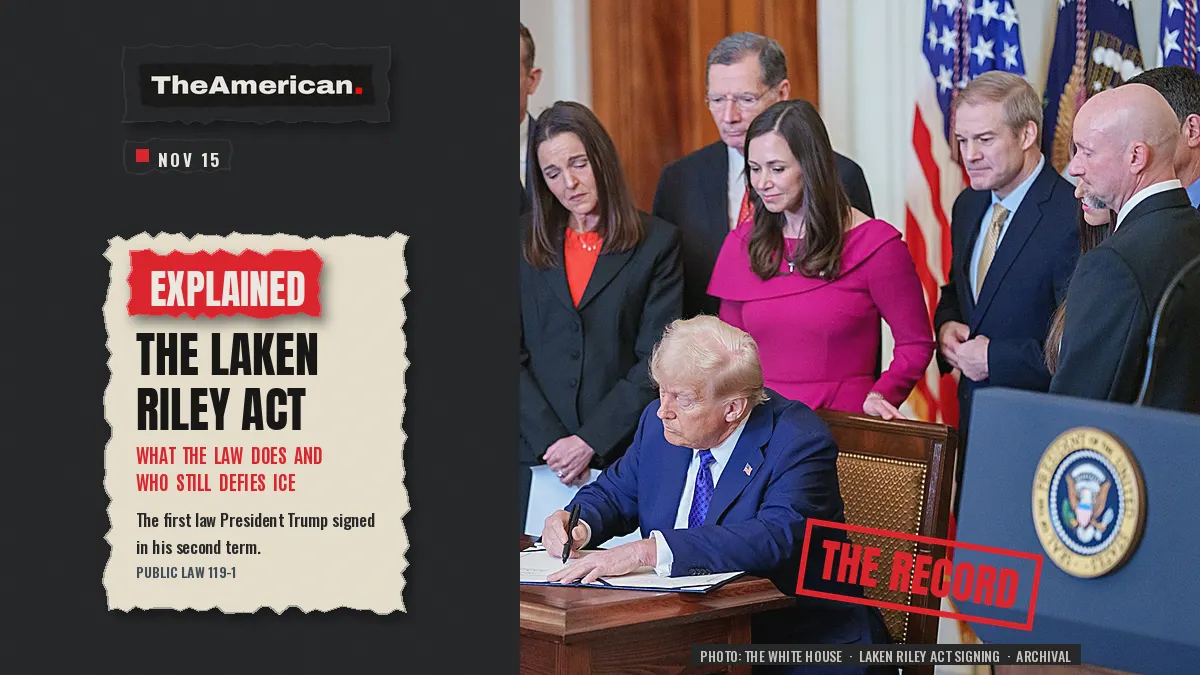
The Laken Riley Act, Public Law 119-1, was the first law President Trump signed in his second term, in January 2025. It passed the Senate 64-35 and the House 263-156, with Democrats in both chambers voting yes. It does two big things.
President Trump hosted Laken Riley's family at the White House and signed the Laken Riley Act into law, which mandates the detention and deportation of illegal alien criminals and allows states to sue if immigration laws aren’t enforced.
@WhiteHouse on X
Mandatory detention. The Department of Homeland Security must detain an illegal alien who is charged with, arrested for, convicted of, or admits to burglary, theft, larceny, shoplifting, assaulting a law enforcement officer, or any crime that results in death or serious bodily injury. Under the old rules, Ibarra's shoplifting citation came and went. Under this law, that arrest means custody.
States can sue. State governments can now take Washington to court when federal immigration failures hurt them or their residents, including financial harm of more than $100. That covers releasing an alien from custody, handing out parole in bulk instead of case by case, and failing to detain someone already ordered removed. Any future administration that waves people through will answer to the states in court.
What is an ICE detainer?
A federal law only works if agents can find the people it covers. Most criminal aliens are first arrested by local police, not ICE. That's where the detainer comes in.
An ICE detainer asks a local jail to notify ICE before it releases someone who may be deportable, and to hold that person briefly so ICE can take custody, as ICE explains. Cooperating jails hand the suspect over at the jailhouse door. Sanctuary jails ignore the request and open the door.
Which cities and states are sanctuary jurisdictions?
In August 2025, under an executive order Trump signed to protect communities from criminal aliens, the Justice Department published its official list of sanctuary jurisdictions. It names:
- States: California, Colorado, Connecticut, Delaware, Illinois, Minnesota, Nevada, New York, Oregon, Rhode Island, Vermont, and Washington, plus the District of Columbia.
- Counties: Baltimore County, Maryland; Cook County, Illinois; San Diego County, California; and San Francisco County, California.
- Cities: Albuquerque, Berkeley, Boston, Chicago, Denver, East Lansing, Hoboken, Jersey City, Los Angeles, New Orleans, New York City, Newark, Paterson, Philadelphia, Portland, Rochester, Seattle, and San Francisco.
DOJ says the list isn't complete and will be updated, and it will help any jurisdiction that wants off the list drop its sanctuary policies. In 2025, Louisville's mayor agreed to revoke the city's sanctuary policies after a DOJ letter threatening legal action. DOJ has also sued sanctuary jurisdictions, including New York City in July 2025.
What sanctuary policies look like on the ground
New York is the worst of it. ICE data released by DHS show the state didn't honor 16,070 ICE detainers from January 2025 through early October 2026. Those detainers are tied to 52,503 criminal charges and convictions, including 131 homicides, 132 kidnappings, 1,017 sexual offenses, 1,776 robberies, 2,198 weapons offenses, and 9,502 assaults.
Take one case from 2026. ICE says the NYPD arrested Alpha Bah, an illegal alien from Guinea, on charges including aggravated assault on a police officer with a deadly weapon. ICE lodged a detainer the same day. The NYPD let him go without telling ICE, according to DHS. That was the second time the city ignored a detainer for him. ICE officers later tracked him down and arrested him, Fox News reported. We covered the case here.
New York has company. DHS says sanctuary politicians in California released Aman Kumar, charged with a felony hit-and-run that injured a 4-year-old boy. In Oregon, officials released Rajinder Kumar, charged with criminally negligent homicide in a crash that killed a newlywed couple, despite an ICE detainer, according to DHS. ICE arrested both after they got out. Every sanctuary release sends agents into neighborhoods to hunt for someone they could have picked up safely at a jail.
Why it matters
The Laken Riley Act fixed the federal side. If an illegal alien is arrested for theft or violence, DHS has to hold him. Sanctuary politicians are the last hole in the fence. They don't stop deportations. They make every arrest more dangerous for officers, and every release is a gamble with somebody else's daughter.
Sanctuary backers say their policies build trust. Trust for whom? Working with ICE isn't cruelty. It's the least a city owes the people it's supposed to protect.
FAQ
What is the Laken Riley Act?
A federal law, Public Law 119-1, that requires DHS to detain illegal aliens charged with or arrested for theft, burglary, shoplifting, assaulting police, or crimes causing death or serious injury, and that lets states sue over federal immigration failures.
Who was Laken Riley?
A 22-year-old Georgia nursing student murdered while running. Jose Antonio Ibarra, a Venezuelan national who entered illegally, was convicted and sentenced to life without parole.
What is a sanctuary city?
A jurisdiction with laws or policies that limit cooperation with federal immigration enforcement, such as refusing to honor ICE detainers.
Which cities are sanctuary cities?
DOJ's list includes Chicago, Los Angeles, New York City, Philadelphia, Boston, Denver, Seattle, San Francisco, and others, plus 12 states and the District of Columbia.
How many ICE detainers has New York ignored?
DHS says New York did not honor 16,070 ICE detainers from January 2025 through early October 2026.
Related: NYPD Ignored ICE Twice. Now the Illegal Immigrant Charged With Assaulting a Cop Is at Large.; RECORD YEAR: ICE Posts the Most Arrests and Deportations in Agency History; D.C. Democratic Mayoral Nominee Promises Day-1 Orders Pulling Police Off ICE Work