Table of Contents
Nine days after the midterms, the man who will hold the House gavel in January was already talking about changing America's military assistance to Israel.
House Democratic Leader Hakeem Jeffries, asked Thursday whether he supported a Senate push to strip U.S.-Israel defense and intelligence cooperation out of this year's National Defense Authorization Act, did not endorse the idea. He also didn't defend the status quo.
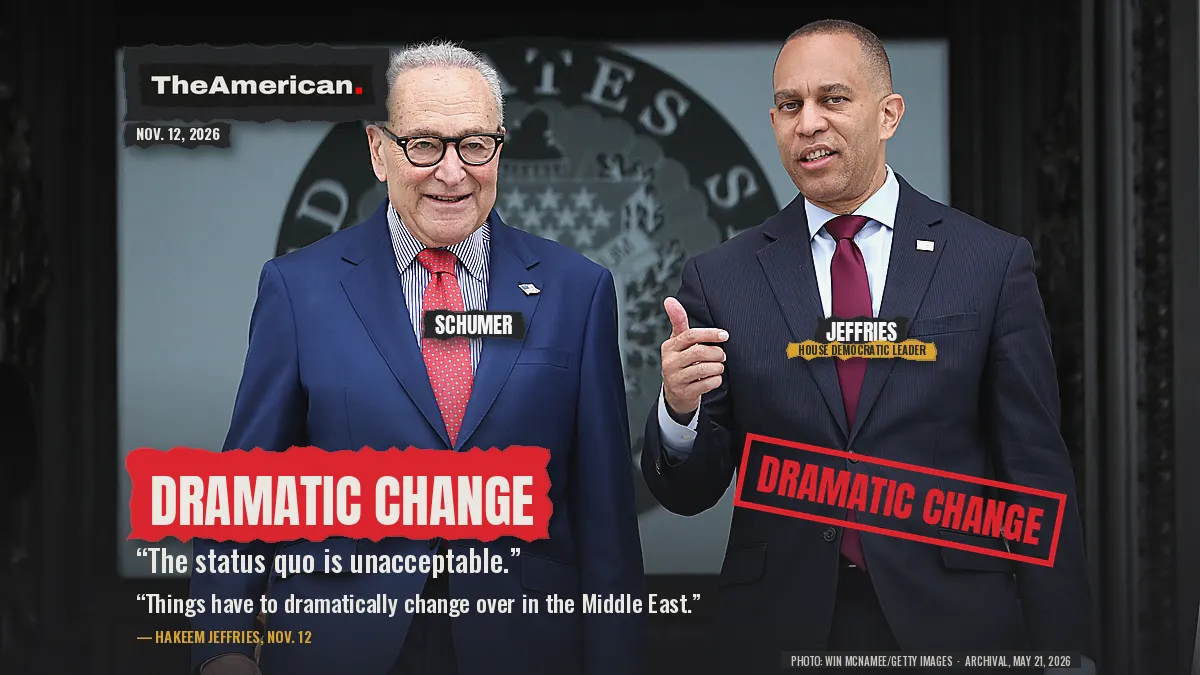
"I haven't had a conversation with Senator Van Hollen, but what I have said is that things have to dramatically change over in the Middle East," Jeffries said at a Washington press briefing, according to the Jerusalem Post.
"We need dramatic change in the West Bank, which is why I strongly support the West Bank Violence Protection Act. We need dramatic change in Gaza, and we need dramatic change with respect to the Memorandum of Understanding as it winds down, all of which I've previously said publicly."
The current U.S.-Israel Memorandum of Understanding, the Post noted, provides $38 billion in military assistance over ten years and expires in 2028. Jeffries has previously called for reconsidering that framework. On Thursday he stopped short of saying he wants the aid cut off, and short of backing the NDAA takedown. "Dramatic change" was the phrase he kept using. "The status quo is unacceptable."
The Senate letter already on the table
The question he was asked is not theoretical. Sen. Chris Van Hollen of Maryland sent a letter Tuesday to House and Senate leadership, joined by 11 colleagues including Sens. Elizabeth Warren, Bernie Sanders and Tammy Duckworth, demanding that two NDAA provisions come out: Section 1217 of the Senate bill, the United States-Israel Framework for Upgraded Technologies, Unified Research, and Enhanced Security (FUTURES) Act, and Section 219 of the House bill, the United States-Israel Defense Cooperation Initiative.
Those sections would deepen U.S.-Israel cooperation on weapons technology, including artificial intelligence and quantum technology, Defense News reported Thursday. The letter also takes aim at a fiscal 2027 Intelligence Authorization Act provision that would enhance intelligence-sharing, language written to help Israel "maintain its qualitative military edge" and "deter and counter destabilizing activities by the Government of Iran and Iran-aligned state and nonstate actors that threaten Israel, United States forces, and regional partners."
Van Hollen's letter argues the bills "would constrain the administration's ability to independently determine how best to protect U.S. national security and would lock in long-term commitments despite our serious concerns with the Israeli government's actions in Gaza, the West Bank, and other parts of the region." His office told Defense News he "will continue to push to remove these provisions."
Jeffries, for his part, sketched a two-state line: "a safe and secure Israel living side by side as a Jewish and democratic state with an independent Palestinian state." He said the caucus would "bring about the just and lasting peace that Israelis and Palestinians deserve."
He also lit into the Iran war at the same briefing, calling it a "reckless and costly war of choice" and a "disaster for the American people." "The Iranian regime is stronger now than it was before the war. We should have never entered into it," he said. "House Democrats have uniformly opposed providing any additional money to Donald Trump's war machine, to Pete Hegseth's war machine over in the Middle East."
President Trump and Prime Minister Benjamin Netanyahu have already been talking about moving from aid to a partnership, a shift Israel's PMO welcomed. Jeffries wants "dramatic change" as that memorandum winds down. Van Hollen wants the defense-tech cooperation pulled out of a must-pass bill. The incoming speaker hasn't signed that letter. He also hasn't told Van Hollen to sit down.