Table of Contents
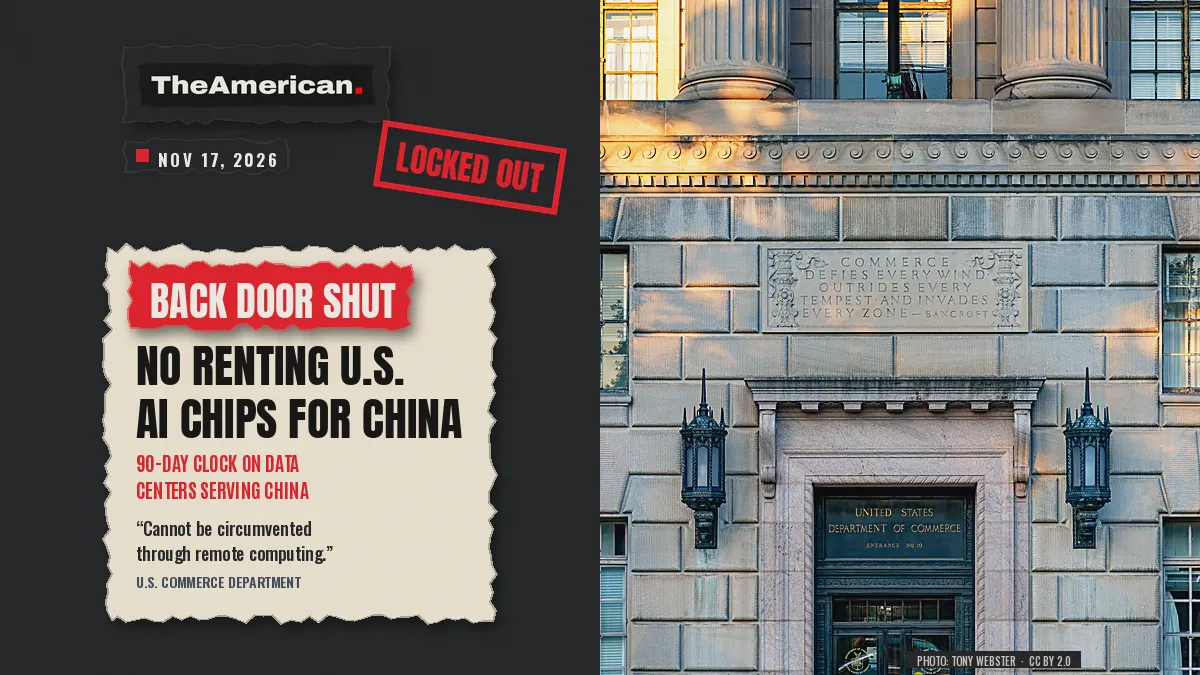
- The Commerce Department released a rule Monday to stop companies in China and other countries of concern from renting American AI computing power through data centers in third countries.
- Data centers anywhere that give Chinese-headquartered companies access above a set computing threshold will need a license, and existing arrangements get 90 days to get one.
- Advanced chip shipments to Indonesia, Malaysia, Singapore, Thailand and Brazil now need a license because of diversion risk, with an exemption for U.S.-headquartered customers who report monthly.
- The rule formally scraps the Biden-era AI Diffusion Rule and is expected to take effect Thursday when it is published in the Federal Register.
- Beijing's foreign ministry said China "will take necessary measures to resolutely safeguard its legitimate rights and interests."
China found a side door into America's best AI chips. On Monday, the Trump administration started bolting it shut.
For years the trick has been simple. Chinese companies can't legally buy the most advanced American processors. So they rent them instead, logging in to data centers in places like Singapore or Malaysia and running their models on U.S. hardware from thousands of miles away. Same chips. Different zip code.
The Commerce Department's Bureau of Industry and Security put out an interim final rule on Monday aimed squarely at that loophole. BIS said the goal is to make sure existing restrictions "cannot be circumvented through remote computing arrangements involving data centers in third countries."
Here's what it does, according to the rule and an analysis from the law firm Nixon Peabody.
Any data center, anywhere in the world, that gives companies headquartered in China, Macau or other countries of concern access to computing power above a high threshold now needs a license for the chips it's using. Data centers already doing that business get 90 days to apply or risk future restrictions. And if a foreign data center won't hand over its customer checks, that refusal counts as a red flag against the exporter.
Then there's the shipping side. Advanced chips headed to Indonesia, Malaysia, Singapore, Thailand and Brazil now need a license, because the government says those countries pose a diversion risk. There's an exemption for customers headquartered in the United States, as long as the exporter files monthly reports. That keeps Microsoft, Oracle and Amazon building in the region while making it a lot harder for a shell company to play middleman.
Commerce also put countries on notice. The rule says the department will watch for nations that "tolerate evasion" and consider consequences up to import restrictions and Entity List designations.
One more thing the rule does. It formally tosses out the Biden administration's AI Diffusion Rule, the sprawling country-tier scheme that tried to ration chips to allies and friends. Nixon Peabody says the new rule is expected to be published and take effect Thursday.
The timing is not subtle. Nvidia's Jensen Huang resigned as CEO last week after reports of an affair with a former executive at Megaspeed, a Singapore company suspected of funneling controlled chips to China, Fortune reported. Megaspeed has denied sending chips to China. Huang had been one of the loudest critics of chip controls on China.
Also worth noting: Commerce said the rule was "written by and at the direction of the Department of Treasury and the National Security Council." Export rules are normally drafted by BIS, Nixon Peabody noted, and the firm read this as a sign of serious pressure inside the government to tighten the screws.
Beijing didn't like it. "China will take necessary measures to resolutely safeguard its legitimate rights and interests," foreign ministry spokesman Guo Jiakun said, according to DW.
Translation: they noticed.
And it lands right as President Trump touches down in Asia. He's in Manila this week for the ASEAN summit with Southeast Asian leaders, the same region where a lot of these data centers are going up, before heading to Shenzhen to sit down with Xi Jinping. If anybody at that table wanted to talk about chips, they now know where America stands.
You can sell the world American technology. You just don't get to hand China the keys through the back door.