Table of Contents
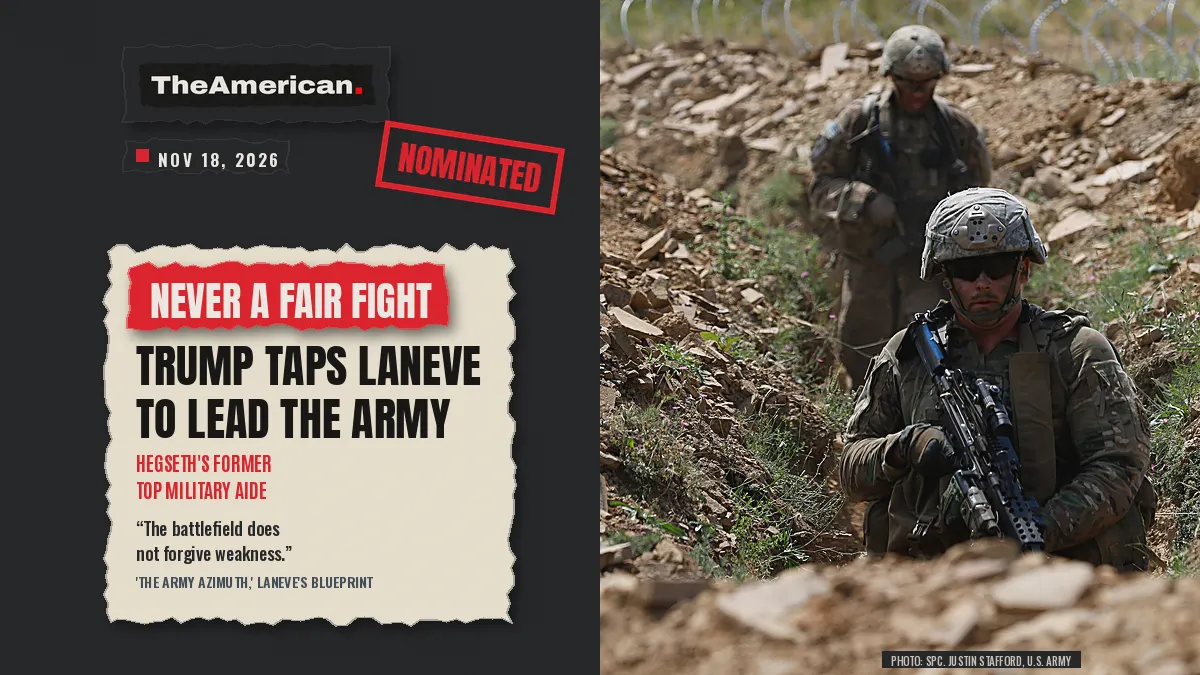
- President Trump formally nominated Gen. Christopher LaNeve to be Army chief of staff, the service's top uniformed officer. The nomination went to the Senate Armed Services Committee.
- LaNeve has run the Army as acting chief since April, when Secretary of War Pete Hegseth fired Gen. Randy George.
- He was Hegseth's senior military assistant in 2025 and became vice chief of staff in February.
- His Army blueprint warns that "every shortcut in training and lapse in discipline will be paid for in blood." The White House also nominated Lt. Gen. Marcus Evans as vice chief.
The Army has had an acting boss since spring. Now President Trump wants to make it official, and he picked the general who already wrote the playbook.
Trump formally nominated Gen. Christopher LaNeve to be Army chief of staff, the top uniformed job in the service, ABC News reported. The nomination reached the Senate this week and went to the Armed Services Committee, according to The Daily Wire.
LaNeve isn't new to the chair. He has run the Army on an acting basis since April, when Secretary of War Pete Hegseth fired Gen. Randy George. For months, LaNeve has done two jobs at once, acting chief and vice chief.
His rise has been fast. In less than two years, he went from a senior command in South Korea to one of Hegseth's top military aides to vice chief of staff, the Army's second-highest uniformed post, ABC News reported. He became Hegseth's senior military assistant in 2025. The Senate confirmed him as vice chief in January, and he took that post in February.
Critics will call that too close to the boss. Here's another way to see it. The Secretary of War wants an Army that fights, and he picked a man who has said so in writing.
That writing is called "The Army Azimuth," and it reads like it was written by a soldier, not a consultant.
"America's Army applies violence decisively on battlefields marked by unrelenting speed, precision lethality, and persistent observation," it says. "We secure our Nation's borders, protect the American people against attack, and respond to domestic crises." It calls those "our most sacred duties."
Then it gets blunt. "The next war will not look like our last," the document says. "The battlefield does not forgive weakness."
And this one should be framed in every barracks: "Every shortcut in training and lapse in discipline will be paid for in blood."
The plan talks about weapons that can "strike deep and sink ships at sea," and air defenses rebuilt for "skies saturated with unmanned systems." It promises to pair soldiers' "human ingenuity and judgment with advanced technologies like autonomy and artificial intelligence."
Its closing line is the whole point. It calls for an Army that is "disciplined, lethal, and relentless," one that "closes with and destroys the enemy, leaving no doubt about the will and power of the United States."
LaNeve followed that up last month with "How the Army Fights," a guide to taking on a near-peer enemy like Russia or China. At a major Army convention in Washington, he said a fight like that "should never ever be a fair fight."
Good. It shouldn't be.
This isn't a desk general, either. LaNeve is a 36-year infantry officer from Pittsburgh. He has commanded the 82nd Airborne Division, the Eighth Army in South Korea and the 7th Army Training Command in Germany.
"Deeply honored by the President's trust and confidence," LaNeve said of the pick. The White House also nominated Lt. Gen. Marcus Evans to replace him as vice chief.
Now the clock. The Senate has to act, and time is short. Democrats take control of the Senate on Jan. 3.
That's the fight to watch. Senate Republicans have a few weeks to put the Army's own acting chief in the job for real, before a Democratic majority gets to decide who leads soldiers into the next war.
If they're smart, they'll move fast. The Army has waited since April. The blueprint is already written. Let the man run it.