Table of Contents
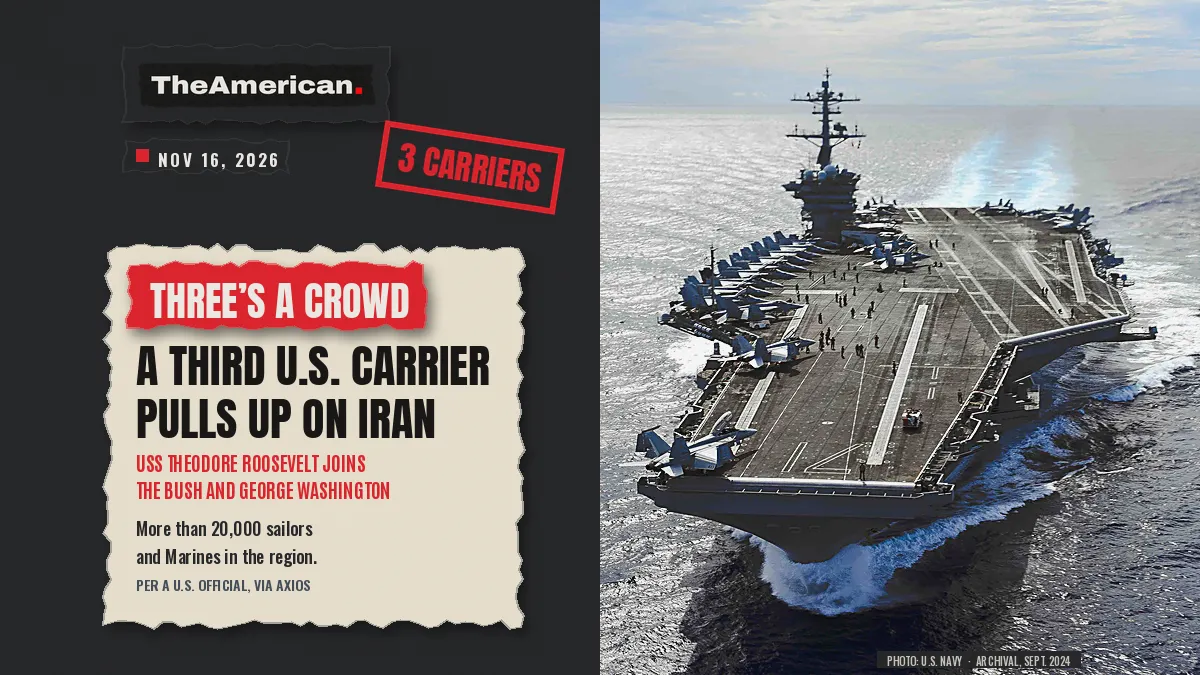
- The aircraft carrier USS Theodore Roosevelt arrived in the Middle East on Sunday, a U.S. official told Axios and The National.
- It joins the carriers USS George H.W. Bush and USS George Washington, giving the U.S. three carrier strike groups in Central Command's area at once.
- With escorts and other forces, the American presence now tops 20,000 sailors and Marines and hundreds of aircraft.
- It is the second time this year the U.S. has massed three carriers in the region, after April, which was the first time since 2003.
- Reuters reported President Trump may hold off on new strikes unless Iran or its Houthi proxies provoke the U.S.
Iran wanted to test America this weekend. America answered with a third aircraft carrier.
The USS Theodore Roosevelt pulled into Middle Eastern waters on Sunday, a U.S. official told Axios and The National. The Nimitz-class carrier joins the USS George H.W. Bush and the USS George Washington. That's three carrier strike groups inside Central Command's area at the same time.
Count it up. More than 20,000 sailors and Marines. Hundreds of aircraft. Escorts that include the cruiser USS Chosin, The Week reported. A floating air force parked off the coast of a regime that can't pay its own bills.
Think about what one of these ships is. A Nimitz-class carrier runs nearly 1,100 feet long, powered by nuclear reactors, with dozens of fighter jets, helicopters and other aircraft on board. It's a mobile air base that doesn't need anybody's permission to operate. No host country, no landing rights, no foreign parliament vote. Now there are three of them in the neighborhood.
The Roosevelt was first supposed to relieve the George Washington. It didn't. Officials have said all three groups can stay as long as they're needed, and the Bush's deployment has already been extended. Three carriers in the region happened once before this year, in April. Before that, you had to go back to 2003.
The timing isn't subtle. On Sunday Iran's Revolutionary Guards said they launched drones at a base in Bahrain that hosts U.S. Army assets. Bahrain's military said its air defenses destroyed several aerial threats before they hit anything, and Bahrain's Foreign Ministry called it "blatant aggression." Two days earlier the IRGC claimed it had destroyed an American early-warning radar in Bahrain. U.S. Central Command said it had simply shot down the two drones. Iranian state TV is also claiming that several vessels hit mines in the Gulf over the weekend, without naming a single ship.
So that's Tehran's pitch. Drones that don't land, a radar that's still standing and mystery ships nobody can name.
Here's America's. Three flight decks, and a president who gets to choose what happens next.
Reuters reported Saturday that President Trump is considering holding off on new strikes unless Iran or the Houthis in Yemen launch fresh provocations. Call it leverage. The blockade is choking the regime, and Treasury Secretary Scott Bessent said Sunday that Iran's economy is in one of the fastest collapses in history. The carriers make sure the mullahs understand the other option is still on the table.
Trump leaves Monday for Asia, with a stop in Manila before a summit in Shenzhen with Xi Jinping and Vladimir Putin on Thursday. The White House says Iran will come up there. It's a lot easier to talk about the Middle East with Xi and Putin when three American carriers are sitting in it.
Iran's parliament speaker, Mohammad Bagher Ghalibaf, warned Sunday that if "the Americans make a mistake this time," Iran's forces would decide "the geography of the battle." Big words from a man whose country's currency is in free fall.
Tehran can keep poking. The Navy just brought a third carrier to the fight, and the regime is the one running out of money.